mcp-gopls – MCP server for Go (gopls)




A Model Context Protocol (MCP) server that lets AI assistants use Go’s LSP (gopls) for navigation, diagnostics, testing, coverage, and more.
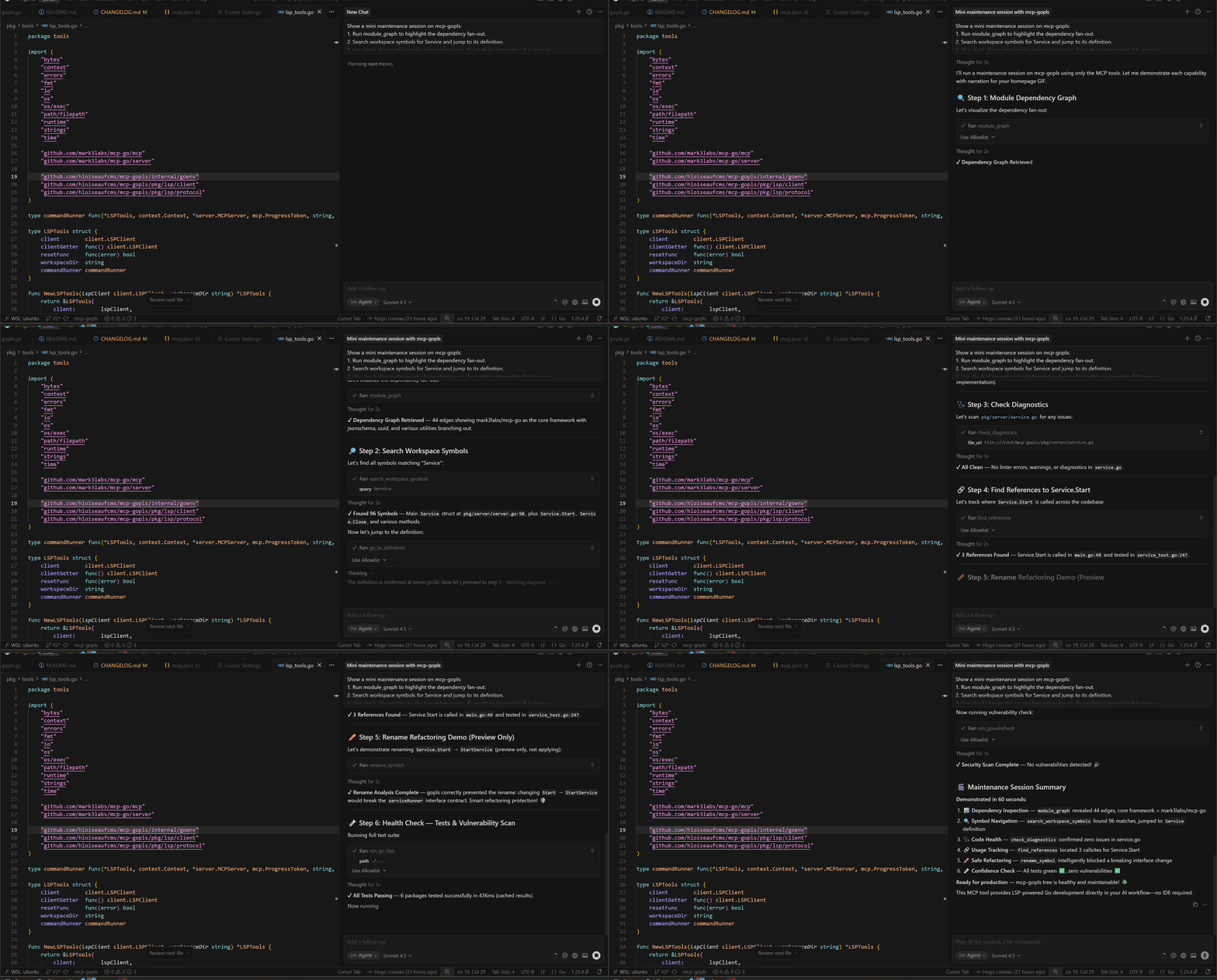
TL;DR: If you use Claude / Cursor / Copilot with Go, mcp-gopls gives the AI full LSP powers:
go-to-definition, references, hover, completion, go test, coverage, go mod tidy, govulncheck, etc.
Overview
This MCP server helps AI assistants to:
- Use LSP to analyze Go workspaces
- Navigate to definitions, references, and workspace symbols
- Format, rename, and inspect code actions without leaving MCP
- Run Go tests, coverage,
go mod tidy, govulncheck, and module graph commands with structured results
- Read workspace resources (overview + go.mod) and consume curated prompts
Status: Actively developed – used in real projects.
Tested with Go 1.25.x and gopls@latest.
Architecture
This project uses the mark3labs/mcp-go library to implement the Model Context Protocol. The MCP integration enables seamless communication between AI assistants and Go tools.
The server communicates with gopls, the official language server for Go, via the Language Server Protocol (LSP).
Features
- Configurable runtime:
--workspace, --gopls-path, --log-level, --rpc-timeout, and --shutdown-timeout flags + env vars (MCP_GOPLS_*)
- Structured logging: Text/JSON logging with slog and optional file output
- Extended LSP surface: navigation, diagnostics, formatting, rename, code actions, hover, completion, workspace symbols
- Test & tooling helpers: coverage analysis,
go test, go mod tidy, govulncheck, go mod graph
- MCP extras: resources (
resource://workspace/overview, resource://workspace/go.mod) and prompts (summarize_diagnostics, refactor_plan)
- Progress streaming: long-running commands emit
notifications/progress events so clients can surface status updates
Feature comparison: mcp-gopls vs built-in gopls MCP
As of gopls v0.20.0, the built-in MCP server exposes these tools:
go_context, go_diagnostics, go_file_context, go_file_diagnostics,
go_file_metadata, go_package_api, go_references, go_rename_symbol,
go_search, go_symbol_references, go_workspace, go_vulncheck.
If you want full LSP-like editing + tooling from MCP (definition, hover, completion, format, rename, code actions, go test, coverage, go mod tidy, module graph), mcp-gopls is strictly richer.
If you mostly want read-only/introspective tools (diagnostics, symbol search, references, package API, workspace/file context, vulncheck) with no extra binary, the built-in gopls MCP is enough.
Note: The built-in gopls MCP server is still marked experimental and its tool set may change over time. This comparison is accurate as of gopls v0.20.x.
Project Structure
.
├── cmd
│   └── mcp-gopls        # Application entry point
├── pkg
│   ├── lsp             # LSP client to communicate with gopls
│   │   ├── client      # LSP client implementation
│   │   └── protocol    # LSP protocol types and features
│   ├── server          # MCP server
│   └── tools           # MCP tools exposing LSP features
Installation
go install github.com/hloiseau/mcp-gopls/v2/cmd/mcp-gopls@latest
Quick Start
- Install the server:
go install github.com/hloiseau/mcp-gopls/v2/cmd/mcp-gopls@latest
- Verify it's on your
$PATH:
mcp-gopls --help
- Configure your AI client (see examples below for Cursor, Claude Desktop, or GitHub Copilot).
Docker / MCP Gateway
If you prefer to run mcp-gopls in a container (for Docker MCP Gateway or other containerized setups), use the official image.
Docker run
docker run --rm -i \
  -v /absolute/path/to/your/go/project:/workspace \
  ghcr.io/hloiseau/mcp-gopls:latest \
  --workspace /workspace
docker-mcp.yaml
Copy docs/docker-mcp.yaml, update the bind mount path, then run from that directory:
docker mcp gateway run
If your MCP catalog tooling requires a toolsUrl, use docs/tools.json as a static tool list.
Detailed Client Setup
Note: All clients point to the same command:
mcp-gopls --workspace /absolute/path/to/your/go/project
The configuration format differs slightly per client, but the binary and arguments remain identical.
1. Connect from Cursor
- Open Settings → MCP Servers → Edit JSON.
- Add or update the
mcp-gopls entry:
{
  "mcpServers": {
    "mcp-gopls": {
      "command": "mcp-gopls",
      "args": ["--workspace", "/absolute/path/to/your/go/project"],
      "env": {
        "MCP_GOPLS_LOG_LEVEL": "info"
      }
    }
  }
}
- Run Developer: Reload Window so Cursor reconnects.
- Open the Tools drawer in Cursor Chat and enable
mcp-gopls.
Client Setup Examples
Claude Desktop (macOS, Windows, Linux)
- Install
mcp-gopls and make sure it is on your $PATH.
- Create or edit
claude_desktop_config.json.
- macOS:
~/Library/Application Support/Claude/claude_desktop_config.json
- Linux:
~/.config/Claude/claude_desktop_config.json
- Windows:
%APPDATA%\Claude\claude_desktop_config.json
- Add the server entry:
{
  "mcpServers": {
    "mcp-gopls": {
      "command": "mcp-gopls",
      "args": ["--workspace", "/absolute/path/to/your/go/project"],
      "env": {
        "MCP_GOPLS_LOG_LEVEL": "info"
      }
    }
  }
}
Restart Claude Desktop, open a chat, and ask it to connect to the mcp-gopls tool (Claude will show a “Tools” tab once the server is detected). Typical prompts include “list diagnostics for cmd/api/server.go” or “rename userService to accountService.”
Cursor IDE
In Cursor open Settings → MCP Servers → Edit JSON (this writes to ~/.cursor/config.json or the project-local override). Add:
{
  "mcpServers": {
    "mcp-gopls": {
      "command": "mcp-gopls",
      "args": ["--workspace", "/absolute/path/to/your/go/project"]
    }
  }
}
Reload Cursor (or run the Developer: Reload Window command) and the server will appear inside the “Tools” drawer. You can now ask Cursor Chat things like “run go test ./pkg/server with coverage” or “show hover info for pkg/tools/tests.go:42.”
GitHub Copilot (Agent Mode)
GitHub Copilot’s Agent Mode can talk to local MCP servers across VS Code, JetBrains IDEs, Eclipse, and Xcode (docs). To wire mcp-gopls in VS Code:
- Update GitHub Copilot (requires VS Code 1.99+), opt into Agent Mode.
- Create
.vscode/mcp.json in your workspace (or edit the global file shown in the Copilot “Edit config” dialog).
- Add:
{
  "servers": {
    "mcp-gopls": {
      "type": "stdio",
      "command": "mcp-gopls",
      "args": ["--workspace", "/absolute/path/to/your/go/project"],
      "env": {
        "MCP_GOPLS_LOG_LEVEL": "warn"
      }
    }
  }
}
- Reload Agent Mode (toggle off/on) so Copilot discovers the new tool; the chat “Tools” picker will now expose every MCP action (
run_go_test, run_govulncheck, etc.). JetBrains and other IDEs share the same JSON schema via their Copilot settings panel.
MCP Inspector / CLI testing
For quick smoke tests or demos you can use mark3labs/mcp-inspector:
npx -y @mark3labs/mcp-inspector \
  --command mcp-gopls \
  --args "--workspace" "/absolute/path/to/your/go/project"
The inspector lets you call each tool/resource/prompt manually, which is handy for debugging server configuration before wiring it into an AI assistant.
Progress Notifications
Long-running tools emit structured notifications/progress events so IDEs can show rich status indicators:
- Streaming progress (
run_go_test, analyze_coverage, run_govulncheck, run_go_mod_tidy) forwards incremental log lines and percentage updates. Cursor displays these as a live log.
- Start/complete events only (
go_to_definition, find_references, rename_symbol, etc.) fire a quick “started” event so the UI can show a spinner, followed by a completion payload with the final result.
- Each progress token is now namespaced (e.g.,
run_go_test/<rand>) to avoid “unknown token” errors when multiple tools run concurrently.
When integrating new tools, opt into streaming mode only if the underlying LSP/golang command produces meaningful interim output; otherwise stick to the lightweight start/complete flow to minimize noise.
Prompt Instructions
Both prompts are accessible from any MCP-aware client via the “Prompts” catalog.
summarize_diagnostics
- When to use: After
check_diagnostics or run_go_test to turn raw diagnostics into actionable steps.
- Arguments: None. The server automatically reads the last diagnostics payload cached by the tools layer.
- Typical workflow:
check_diagnostics → copy the returned array into the prompt input field (Cursor’s UI pastes it automatically when you select “Use last result”).
refactor_plan
- When to use: You already have a diagnostics JSON array and want a concise change checklist.
- Arguments: Requires a
diagnostics object containing the raw Go diagnostics (the same payload returned by check_diagnostics).
- Example invocation payload:
{
  "diagnostics": [
    {
      "uri": "file:///path/to/pkg/tools/workspace.go",
      "range": {"start": {"line": 12, "character": 5}, "end": {"line": 12, "character": 25}},
      "severity": 1,
      "message": "unused variable testHelper"
    }
  ]
}
The prompt responds with a numbered set of refactor steps plus suggested validation commands (go test, analyze_coverage, etc.).
Configuration
The server supports various configuration options via command-line flags and environment variables:
Command-Line Flags
Environment Variables
All flags can be set via environment variables with the MCP_GOPLS_ prefix:
Command-line flags take precedence over environment variables.
Troubleshooting
- “column is beyond end of line” – gopls could not map the provided position. Confirm the file is saved and the position uses zero-based lines/columns; run
go fmt to ensure tabs vs. spaces align with gopls expectations.
- “no hover information available” – the symbol might belong to a generated file or a module outside the configured workspace. Ensure the
--workspace flag points to the module root and that go list ./... succeeds.
- “workspace not initialized” – the server did not finish its initial sync. Wait for the
workspace initialized log line or restart mcp-gopls after deleting stale .gopls caches.
run_govulncheck missing binary – the tool now falls back to go run golang.org/x/vuln/cmd/govulncheck@latest, but the machine still needs outbound network access. Install the binary manually if the fallback is blocked.
Usage Example
Using the server with AI assistants that support MCP:
# Ask the AI to get information about the code
Can you find the definition of the `ServeStdio` function in this project?

# Ask for diagnostics
Are there any errors in my main.go file?

# Ask for information about a symbol
What does the Context.WithTimeout function do in Go?
Development
git clone https://github.com/hloiseau/mcp-gopls.git
cd mcp-gopls
go mod tidy
go test ./...
go build ./cmd/mcp-gopls
Table-driven tests live under pkg/tools and CI runs via .github/workflows/ci.yml.
Documentation
docs/usage.md – quickstart and tool catalog walkthrough- Workspace resources expose
resource://workspace/overview and resource://workspace/go.mod
- Prompts (
summarize_diagnostics, refactor_plan) help assistants produce consistent outputs
Contributing
PRs and issues are welcome!
- Check open issues or file a new one if you hit a bug or want a feature.
- Run
go test ./... before opening a PR.
- For bigger changes (new tools, protocol changes), please open a design issue first so we can discuss the approach.
All contributions should maintain test coverage and adhere to Go best practices. See the Development section for setup instructions.
Prerequisites
- Go 1.25+ (tested with
go1.25.4)
gopls installed (go install golang.org/x/tools/gopls@latest)- Optional:
govulncheck (go install golang.org/x/vuln/cmd/govulncheck@latest)
- The server forces
GOTOOLCHAIN=local for its nested gopls process. If you need a different toolchain, set GOTOOLCHAIN in the environment before launching mcp-gopls.
Integration with Ollama
This MCP server can be used with any tool that supports the MCP protocol. For Ollama integration:
- Make sure Ollama is running
- The MCP server runs independently and communicates through stdin/stdout
- Configure your client to use the MCP server as a tool provider
License
Apache License 2.0