ContextForge
An open source registry and proxy that federates MCP, A2A, and REST/gRPC APIs with centralized governance, discovery, and observability. Optimizes Agent & Tool calling, and supports plugins.






ContextForge is an open source registry and proxy that federates tools, agents, and APIs into one clean endpoint for your AI clients. It provides centralized governance, discovery, and observability across your AI infrastructure:
- Tools Gateway — MCP, REST, gRPC-to-MCP translation, and TOON compression
- Agent Gateway — A2A protocol, OpenAI-compatible and Anthropic agent routing
- API Gateway — Rate limiting, auth, retries, and reverse proxy for REST services
- Plugin Extensibility — 40+ plugins for additional transports, protocols, and integrations
- Observability — OpenTelemetry tracing with Phoenix, Jaeger, Zipkin, and other OTLP backends
It runs as a fully compliant MCP server, deployable via PyPI or Docker, and scales to multi-cluster environments on Kubernetes with Redis-backed federation and caching.
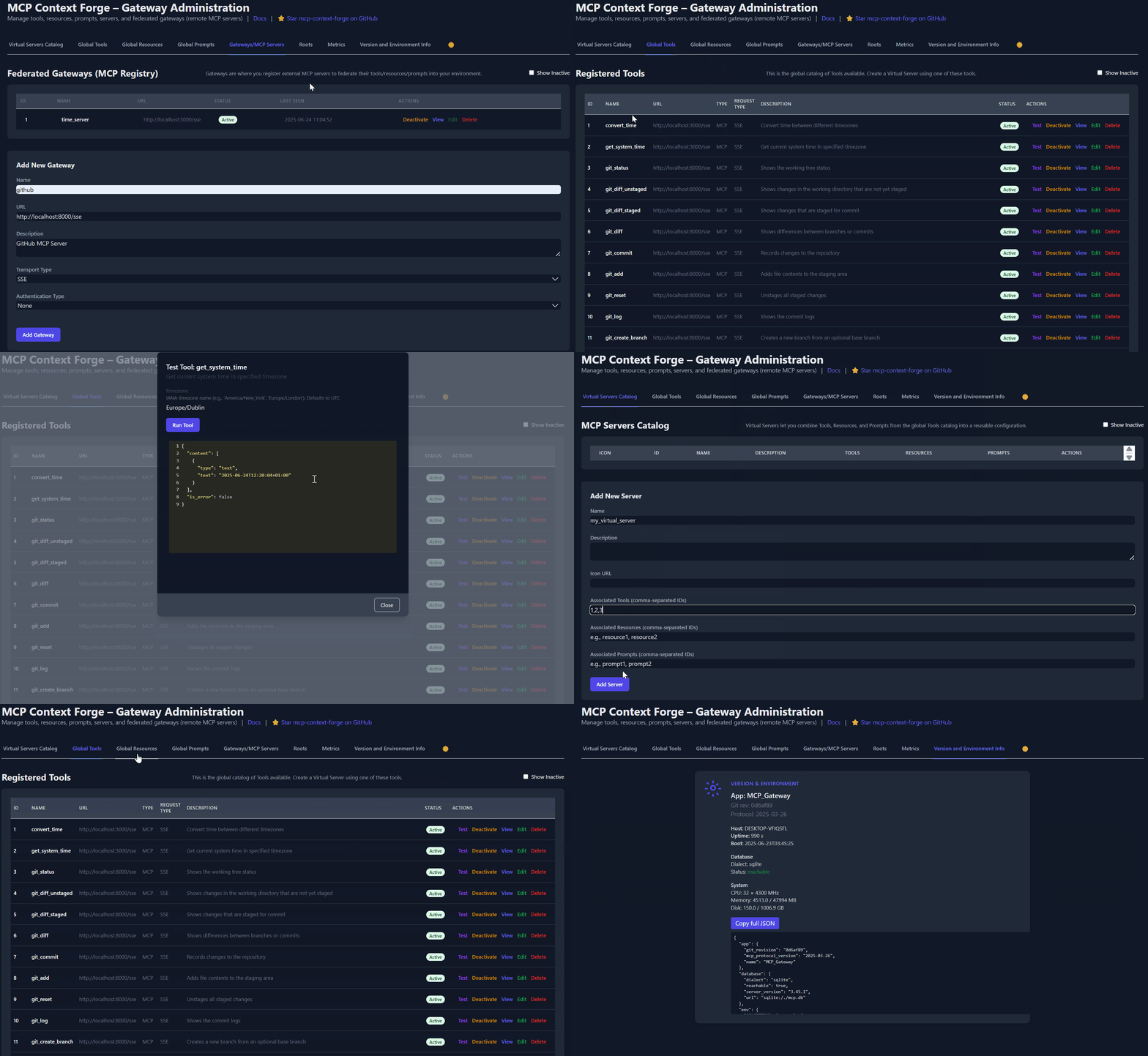
Table of Contents
📌 Quick Links
Overview & Goals
ContextForge is an open source registry and proxy that federates any Model Context Protocol (MCP) server, A2A server, or REST/gRPC API, providing centralized governance, discovery, and observability. It optimizes agent and tool calling, and supports plugins. See the project roadmap for more details.
It currently supports:
- Federation across multiple MCP and REST services
- A2A (Agent-to-Agent) integration for external AI agents (OpenAI, Anthropic, custom)
- gRPC-to-MCP translation via automatic reflection-based service discovery
- Virtualization of legacy APIs as MCP-compliant tools and servers
- Transport over HTTP, JSON-RPC, WebSocket, SSE (with configurable keepalive), and Streamable HTTP; stdio transport available for server-side use
- An Admin UI for real-time management, configuration, and log monitoring (with airgapped deployment support)
- Built-in auth, retries, and rate-limiting with user-scoped OAuth tokens and unconditional X-Upstream-Authorization header support
- OpenTelemetry observability with Phoenix, Jaeger, Zipkin, and other OTLP backends
- Scalable deployments via Docker or PyPI, Redis-backed caching, and multi-cluster federation

For a list of upcoming features, check out the ContextForge Roadmap
🔌 Gateway Layer with Protocol Flexibility
- Federates any MCP server or REST API
- Lets you choose your MCP protocol version (e.g.,
2025-11-25)
- Exposes a single, unified interface for diverse backends
🧩 Virtualization of REST/gRPC Services
- Wraps non-MCP services as virtual MCP servers
- Registers tools, prompts, and resources with minimal configuration
- gRPC-to-MCP translation via server reflection protocol
- Automatic service discovery and method introspection
🔁 REST-to-MCP Tool Adapter
🧠 Unified Registries
- Prompts: Jinja2 templates, multimodal support, rollback/versioning
- Resources: URI-based access, MIME detection, caching, SSE updates
- Tools: Native or adapted, with input validation and concurrency controls
📈 Admin UI, Observability & Dev Experience
- Admin UI built with HTMX 2.0.3 (bundled) + Alpine.js
- Real-time log viewer with filtering, search, and export capabilities
- Auth: Basic, JWT, or custom schemes
- Structured logs, health endpoints, metrics
- 7,000+ tests, Makefile targets, live reload, pre-commit hooks
🔍 OpenTelemetry Observability
- Vendor-agnostic tracing with OpenTelemetry (OTLP) protocol support
- Multiple backend support: Phoenix (LLM-focused), Jaeger, Zipkin, Tempo, DataDog, New Relic
- Distributed tracing across federated gateways and services
- Automatic instrumentation of tools, prompts, resources, and gateway operations
- LLM-specific metrics: Token usage, costs, model performance
- Zero-overhead when disabled with graceful degradation
See Observability Documentation for setup guides with Phoenix, Jaeger, and other backends.
Quick Start - PyPI
ContextForge is published on PyPI as mcp-contextforge-gateway.
⚠️ JWT_SECRET_KEY and AUTH_ENCRYPTION_SECRET are required in every environment — including local development. The gateway will not start without them. Generate real secrets with python3 -m mcpgateway.scripts.init_secrets before first run.
TLDR — single command using uv:
# 1️⃣  Generate secure secrets (creates .env.secrets)
python3 -m mcpgateway.scripts.init_secrets

# 2️⃣  Export the generated values
export JWT_SECRET_KEY="$(grep '^JWT_SECRET_KEY=' .env.secrets | cut -d= -f2)"
export AUTH_ENCRYPTION_SECRET="$(grep '^AUTH_ENCRYPTION_SECRET=' .env.secrets | cut -d= -f2)"

# 3️⃣  Start the gateway
JWT_SECRET_KEY="$JWT_SECRET_KEY" \
AUTH_ENCRYPTION_SECRET="$AUTH_ENCRYPTION_SECRET" \
MCPGATEWAY_UI_ENABLED=true \
MCPGATEWAY_ADMIN_API_ENABLED=true \
[email protected] \
uvx --from mcp-contextforge-gateway mcpgateway --host 0.0.0.0 --port 4444
📋 Prerequisites
- Python ≥ 3.11
- curl + jq - only for the last smoke-test step
1 - Install & run (copy-paste friendly)
# 1️⃣  Create an isolated env and install from PyPI
mkdir mcpgateway && cd mcpgateway
python3 -m venv .venv && source .venv/bin/activate
pip install --upgrade pip
pip install mcp-contextforge-gateway

# 2️⃣  Download .env.example and generate real secrets
curl -O https://raw.githubusercontent.com/IBM/mcp-context-forge/main/.env.example
cp .env.example .env

# Generate cryptographically secure secrets into .env.secrets
python3 -m mcpgateway.scripts.init_secrets

# Patch the generated secrets into .env (replaces __REPLACE_ME__ placeholders)
python3 -m mcpgateway.scripts.init_secrets --patch-env .env

# 3️⃣  Start the gateway
mcpgateway --host 0.0.0.0 --port 4444 &

# 4️⃣  Generate a bearer token and smoke-test
export JWT_SECRET_KEY=$(grep '^JWT_SECRET_KEY=' .env | cut -d= -f2)
export MCPGATEWAY_BEARER_TOKEN=$(python3 -m mcpgateway.utils.create_jwt_token \
    --username [email protected] --exp 10080 --secret "$JWT_SECRET_KEY")

curl -s -H "Authorization: Bearer $MCPGATEWAY_BEARER_TOKEN" \
     http://127.0.0.1:4444/version | jq
Windows (PowerShell) quick-start
# 1️⃣  Isolated env + install from PyPI
mkdir mcpgateway ; cd mcpgateway
python3 -m venv .venv ; .\.venv\Scripts\Activate.ps1
pip install --upgrade pip
pip install mcp-contextforge-gateway

# 2️⃣  Download .env.example and generate real secrets
Invoke-WebRequest -Uri "https://raw.githubusercontent.com/IBM/mcp-context-forge/main/.env.example" -OutFile ".env.example"
Copy-Item .env.example .env

# Generate cryptographically secure secrets into .env.secrets
python3 -m mcpgateway.scripts.init_secrets

# Patch the generated secrets into .env (replaces __REPLACE_ME__ placeholders)
python3 -m mcpgateway.scripts.init_secrets --patch-env .env

# 3️⃣  Launch the gateway
mcpgateway.exe --host 0.0.0.0 --port 4444

# 4️⃣  Bearer token and smoke-test
$Env:JWT_SECRET_KEY = (Get-Content .env | Select-String '^JWT_SECRET_KEY=').ToString().Split('=')[1]
$Env:MCPGATEWAY_BEARER_TOKEN = python3 -m mcpgateway.utils.create_jwt_token `
    --username [email protected] --exp 10080 --secret $Env:JWT_SECRET_KEY

curl -s -H "Authorization: Bearer $Env:MCPGATEWAY_BEARER_TOKEN" `
     http://127.0.0.1:4444/version | jq
⚡ Alternative: uv (faster)
# 1️⃣  Isolated env + install from PyPI using uv
mkdir mcpgateway ; cd mcpgateway
uv venv
.\.venv\Scripts\activate
uv pip install mcp-contextforge-gateway

# Continue with steps 2️⃣-4️⃣ above...
More configuration
Copy .env.example to .env and tweak any of the settings (or use them as env variables).
🚀 End-to-end demo (register a local MCP server)
# 1️⃣  Spin up the sample MCP time server using mcpgateway.translate & docker (replace docker with podman if needed)
python3 -m mcpgateway.translate \
     --stdio "docker run --rm -i ghcr.io/ibm/fast-time-server:latest -transport=stdio" \
     --expose-sse \
     --port 8003

# Or using the official mcp-server-git using uvx:
pip install uv # to install uvx, if not already installed
python3 -m mcpgateway.translate --stdio "uvx mcp-server-git" --expose-sse --port 9000

# NEW: Expose via multiple protocols simultaneously!
python3 -m mcpgateway.translate \
     --stdio "uvx mcp-server-git" \
     --expose-sse \
     --expose-streamable-http \
     --port 9000
# Now accessible via both /sse (SSE) and /mcp (streamable HTTP) endpoints

# 2️⃣  Register it with the gateway
curl -s -X POST -H "Authorization: Bearer $MCPGATEWAY_BEARER_TOKEN" \
     -H "Content-Type: application/json" \
     -d '{"name":"fast_time","url":"http://localhost:8003/sse"}' \
     http://localhost:4444/gateways

# 3️⃣  Verify tool catalog
curl -s -H "Authorization: Bearer $MCPGATEWAY_BEARER_TOKEN" http://localhost:4444/tools | jq

# 4️⃣  Create a *virtual server* bundling those tools. Use the ID of tools from the tool catalog (Step #3) and pass them in the associatedTools list.
curl -s -X POST -H "Authorization: Bearer $MCPGATEWAY_BEARER_TOKEN" \
     -H "Content-Type: application/json" \
     -d '{"server":{"name":"time_server","description":"Fast time tools","associated_tools":[<ID_OF_TOOLS>]}}' \
     http://localhost:4444/servers | jq

# Example curl
curl -s -X POST -H "Authorization: Bearer $MCPGATEWAY_BEARER_TOKEN" \
     -H "Content-Type: application/json" \
     -d '{"server":{"name":"time_server","description":"Fast time tools","associated_tools":["6018ca46d32a4ac6b4c054c13a1726a2"]}}' \
     http://localhost:4444/servers | jq

# 5️⃣  List servers (should now include the UUID of the newly created virtual server)
curl -s -H "Authorization: Bearer $MCPGATEWAY_BEARER_TOKEN" http://localhost:4444/servers | jq

# 6️⃣  Client HTTP endpoint. Inspect it interactively with the MCP Inspector CLI (or use any MCP client)
npx -y @modelcontextprotocol/inspector
# Transport Type: Streamable HTTP, URL: http://localhost:4444/servers/UUID_OF_SERVER_1/mcp,  Header Name: "Authorization", Bearer Token
Quick Start - Containers
Use the official OCI image from GHCR with Docker or Podman.
Please note: Currently, arm64 is not supported on production. If you are e.g. running on MacOS with Apple Silicon chips (M1, M2, etc), you can run the containers using Rosetta or install via PyPi instead.
🚀 Quick Start - Docker Compose
Important: docker compose up -d does not build the gateway image locally by default — it uses the pre-built image from GHCR. The compose file includes a build: block as a fallback, but local builds require a hermetic wheel closure that is only produced by the CI pipeline. If you see a cryptography or dependency resolution error during build, you are hitting this — just pull the image instead (step 2 below handles this automatically).
You also must have a .env file with real secrets before running docker compose up -d. The gateway will not start with placeholder values.
Get a full stack running with PostgreSQL and Redis:
# 1️⃣  Clone the repository
git clone https://github.com/IBM/mcp-context-forge.git
cd mcp-context-forge

# 2️⃣  Set up .env with real secrets AND pull the pre-built images
cp .env.example .env
python3 -m mcpgateway.scripts.init_secrets --patch-env .env
# .env now has strong JWT_SECRET_KEY and AUTH_ENCRYPTION_SECRET

# Pull pre-built images from GHCR (avoids local build entirely)
docker pull ghcr.io/ibm/mcp-context-forge:latest
echo 'IMAGE_LOCAL=ghcr.io/ibm/mcp-context-forge:latest' >> .env

# Build only the nginx image (small, local-only, builds in seconds)
docker compose build nginx

# 3️⃣  Start the full stack
docker compose up -d

# 4️⃣  Check status
docker compose ps

# 5️⃣  View logs
docker compose logs -f gateway

# 6️⃣  Access Admin UI: http://localhost:8080/admin
#     Login: PLATFORM_ADMIN_EMAIL / PLATFORM_ADMIN_PASSWORD (from .env)

# 7️⃣  Generate an API token
export JWT_SECRET_KEY=$(grep '^JWT_SECRET_KEY=' .env | cut -d= -f2)
docker compose exec gateway python3 -m mcpgateway.utils.create_jwt_token \
  --username [email protected] --exp 10080 --secret "$JWT_SECRET_KEY"
What you get:
- 🗄️ PostgreSQL - Production-ready database with 55+ tables
- 🚀 ContextForge - Full-featured gateway with Admin UI
- 📊 Redis - High-performance caching and session storage
- 🔧 Admin Tools - pgAdmin, Redis Insight for database management
- 🌐 Nginx Proxy - Caching reverse proxy on port 8080
Enable HTTPS (optional):
# Start with TLS enabled (auto-generates self-signed certs)
make compose-tls

# Access via HTTPS: https://localhost:8443/admin

# Or bring your own certificates:
# Unencrypted key:
mkdir -p certs
cp your-cert.pem certs/cert.pem && cp your-key.pem certs/key.pem
make compose-tls

# Passphrase-protected key:
mkdir -p certs
cp your-cert.pem certs/cert.pem && cp your-encrypted-key.pem certs/key-encrypted.pem
echo "KEY_FILE_PASSWORD=your-passphrase" >> .env
make compose-tls
☸️ Quick Start - Helm (Kubernetes)
Deploy to Kubernetes with enterprise-grade features:
# Add Helm repository (when available)
# helm repo add mcp-context-forge https://ibm.github.io/mcp-context-forge
# helm repo update

# For now, use local chart
git clone https://github.com/IBM/mcp-context-forge.git
cd mcp-context-forge/charts/mcp-stack

# Generate secrets first
python3 -m mcpgateway.scripts.init_secrets
JWT_SECRET=$(grep '^JWT_SECRET_KEY=' .env.secrets | cut -d= -f2)
ENC_SECRET=$(grep '^AUTH_ENCRYPTION_SECRET=' .env.secrets | cut -d= -f2)

# Install with PostgreSQL (default)
# IMPORTANT: replace <strong-password> with a real password — do not use 'changeme' in production
helm install mcp-gateway . \
  --set mcpContextForge.secret.PLATFORM_ADMIN_EMAIL=admin@yourcompany.com \
  --set mcpContextForge.secret.PLATFORM_ADMIN_PASSWORD=<strong-password> \
  --set mcpContextForge.secret.BASIC_AUTH_PASSWORD=<strong-password> \
  --set "mcpContextForge.secret.JWT_SECRET_KEY=${JWT_SECRET}" \
  --set "mcpContextForge.secret.AUTH_ENCRYPTION_SECRET=${ENC_SECRET}"

# Check deployment status
kubectl get pods -l app.kubernetes.io/name=mcp-context-forge

# Port forward to access Admin UI
kubectl port-forward svc/mcp-gateway-mcp-context-forge 4444:80
# Access: http://localhost:4444/admin

# Generate API token (reads JWT_SECRET_KEY from the pod's environment)
kubectl exec deployment/mcp-gateway-mcp-context-forge -- \
  python3 -m mcpgateway.utils.create_jwt_token \
  --username [email protected] --exp 10080 --secret "${JWT_SECRET}"
SSRF note: Helm defaults to strict SSRF settings (SSRF_ALLOW_PRIVATE_NETWORKS=false).
If you register in-cluster tool URLs, allow only your cluster CIDRs via
mcpContextForge.config.SSRF_ALLOWED_NETWORKS or, for local-only benchmark
setups, temporarily set SSRF_ALLOW_PRIVATE_NETWORKS=true.
See docs/docs/manage/configuration.md#ssrf-protection and docs/docs/deployment/helm.md.
Enterprise Features:
- 🔄 Auto-scaling - HPA with CPU/memory targets
- 🗄️ Database Choice - PostgreSQL (prod), SQLite (dev)
- 📊 Observability - Prometheus metrics, OpenTelemetry tracing
- 🔒 Security - RBAC, network policies, secret management
- 🚀 High Availability - Multi-replica deployments with Redis clustering
- 📈 Monitoring - Built-in Grafana dashboards and alerting
🐳 Docker (Single Container)
# Generate secrets first (creates .env.secrets)
python3 -m mcpgateway.scripts.init_secrets
export JWT_SECRET_KEY="$(grep '^JWT_SECRET_KEY=' .env.secrets | cut -d= -f2)"
export AUTH_ENCRYPTION_SECRET="$(grep '^AUTH_ENCRYPTION_SECRET=' .env.secrets | cut -d= -f2)"

docker run -d --name mcpgateway \
  -p 4444:4444 \
  -e MCPGATEWAY_UI_ENABLED=true \
  -e MCPGATEWAY_ADMIN_API_ENABLED=true \
  -e HOST=0.0.0.0 \
  -e JWT_SECRET_KEY="${JWT_SECRET_KEY}" \
  -e AUTH_ENCRYPTION_SECRET="${AUTH_ENCRYPTION_SECRET}" \
  -e AUTH_REQUIRED=true \
  -e [email protected] \
  -e PLATFORM_ADMIN_PASSWORD=<strong-password> \
  -e PLATFORM_ADMIN_FULL_NAME="Platform Administrator" \
  -e DATABASE_URL=sqlite:///./mcp.db \
  -e SECURE_COOKIES=false \
  ghcr.io/ibm/mcp-context-forge:latest

# Tail logs
docker logs -f mcpgateway

# Generate API token (using the same secret)
docker run --rm -it \
  -e JWT_SECRET_KEY="${JWT_SECRET_KEY}" \
  ghcr.io/ibm/mcp-context-forge:latest \
  python3 -m mcpgateway.utils.create_jwt_token \
  --username [email protected] --exp 10080 --secret "${JWT_SECRET_KEY}"
Browse to http://localhost:4444/admin and login with PLATFORM_ADMIN_EMAIL / PLATFORM_ADMIN_PASSWORD.
Advanced: Persistent storage, host networking, airgapped
Persist SQLite database:
mkdir -p $(pwd)/data && touch $(pwd)/data/mcp.db && chmod 777 $(pwd)/data
docker run -d --name mcpgateway --restart unless-stopped \
  -p 4444:4444 -v $(pwd)/data:/data \
  -e DATABASE_URL=sqlite:////data/mcp.db \
  -e MCPGATEWAY_UI_ENABLED=true -e MCPGATEWAY_ADMIN_API_ENABLED=true \
  -e HOST=0.0.0.0 -e JWT_SECRET_KEY="${JWT_SECRET_KEY}" \
  -e AUTH_ENCRYPTION_SECRET="${AUTH_ENCRYPTION_SECRET}" \
  -e [email protected] -e PLATFORM_ADMIN_PASSWORD=<strong-password> \
  ghcr.io/ibm/mcp-context-forge:latest
Host networking (access local MCP servers):
docker run -d --name mcpgateway --network=host \
  -v $(pwd)/data:/data -e DATABASE_URL=sqlite:////data/mcp.db \
  -e MCPGATEWAY_UI_ENABLED=true -e HOST=0.0.0.0 -e PORT=4444 \
  -e JWT_SECRET_KEY="${JWT_SECRET_KEY}" -e AUTH_ENCRYPTION_SECRET="${AUTH_ENCRYPTION_SECRET}" \
  ghcr.io/ibm/mcp-context-forge:latest
Airgapped deployment (no internet):
docker build -f Containerfile -t mcpgateway:airgapped .
docker run -d --name mcpgateway -p 4444:4444 \
  -e MCPGATEWAY_UI_AIRGAPPED=true -e MCPGATEWAY_UI_ENABLED=true \
  -e HOST=0.0.0.0 -e JWT_SECRET_KEY="${JWT_SECRET_KEY}" \
  -e AUTH_ENCRYPTION_SECRET="${AUTH_ENCRYPTION_SECRET}" \
  mcpgateway:airgapped
🦭 Podman (rootless-friendly)
podman run -d --name mcpgateway \
  -p 4444:4444 -e HOST=0.0.0.0 -e DATABASE_URL=sqlite:///./mcp.db \
  ghcr.io/ibm/mcp-context-forge:1.0.0-RC-3
Advanced: Persistent storage, host networking
Persist SQLite:
mkdir -p $(pwd)/data && chmod 777 $(pwd)/data
podman run -d --name mcpgateway --restart=on-failure \
  -p 4444:4444 -v $(pwd)/data:/data \
  -e DATABASE_URL=sqlite:////data/mcp.db \
  ghcr.io/ibm/mcp-context-forge:1.0.0-RC-3
Host networking:
podman run -d --name mcpgateway --network=host \
  -v $(pwd)/data:/data -e DATABASE_URL=sqlite:////data/mcp.db \
  ghcr.io/ibm/mcp-context-forge:1.0.0-RC-3
✏️ Docker/Podman tips
.env files - Put all the -e FOO= lines into a file and replace them with --env-file .env. See the provided .env.example for reference.
Pinned tags - Use an explicit version (e.g. 1.0.0-RC-3) instead of latest for reproducible builds.
JWT tokens - Generate one in the running container (reads the secret from the container environment):
docker exec mcpgateway python3 -m mcpgateway.utils.create_jwt_token \
  --username [email protected] --exp 10080 --secret "${JWT_SECRET_KEY}"
Upgrades - Stop, remove, and rerun with the same -v $(pwd)/data:/data mount; your DB and config stay intact.
🚑 Smoke-test the running container
curl -s -H "Authorization: Bearer $MCPGATEWAY_BEARER_TOKEN" \
     http://localhost:4444/health | jq
curl -s -H "Authorization: Bearer $MCPGATEWAY_BEARER_TOKEN" \
     http://localhost:4444/tools | jq
curl -s -H "Authorization: Bearer $MCPGATEWAY_BEARER_TOKEN" \
     http://localhost:4444/version | jq
Quick Start: VS Code Dev Container
Clone the repo and open in VS Code—it will detect .devcontainer and prompt to "Reopen in Container". The container includes Python 3.11, Docker CLI, and all project dependencies.
For detailed setup, workflows, and GitHub Codespaces instructions, see Developer Onboarding.
Installation
make venv install-dev      # create .venv + install deps + build Admin UI
make serve                 # gunicorn on :4444
Rust workspace note:
- Workspace-owned Rust crates live under
crates/ and are picked up by the root Cargo.toml via crates/*.
- Run
cargo build, cargo test, and cargo check from the repo root to cover the shared workspace.
make venv install-dev creates the root .venv, which is also reused by the workspace's PyO3/maturin builds.
Alternative: UV or pip
# UV (faster)
uv venv && source .venv/bin/activate
uv pip install -e '.[dev]'

# pip
python3 -m venv .venv && source .venv/bin/activate
pip install -e ".[dev]"
PostgreSQL adapter setup
Install the psycopg driver for PostgreSQL:
# Install system dependencies first
# Debian/Ubuntu: sudo apt-get install libpq-dev
# macOS: brew install libpq

uv pip install 'psycopg[binary]'   # dev (pre-built wheels)
# or: uv pip install 'psycopg[c]'  # production (requires compiler)
Connection URL format:
DATABASE_URL=postgresql+psycopg://user:password@localhost:5432/mcp
Quick Postgres container:
docker run --name mcp-postgres \
  -e POSTGRES_USER=postgres -e POSTGRES_PASSWORD=mysecretpassword \
  -e POSTGRES_DB=mcp -p 5432:5432 -d postgres
Upgrading
For upgrade instructions, migration guides, and rollback procedures, see:
Configuration
⚠️ If any required .env variable is missing or invalid, the gateway will fail fast at startup with a validation error via Pydantic.
Copy the provided .env.example to .env and update the security-sensitive values below.
🔐 Required: Set Before Starting
These variables must be set before the gateway will start. There are no usable defaults — the application fails at startup if these are missing or placeholder values:
These variables have insecure defaults and should be changed before production use:
🔒 Security Defaults (Secure by Default)
These settings are enabled by default for security—only disable for backward compatibility:
🛡️ Content Security
Content size limits prevent DoS attacks and ensure system stability:
Note: Size limits apply only to new create/update operations. Existing content is not retroactively validated.
🌐 UAID Cross-Gateway Routing Security
UAID Security Configuration
Production Requirements:
Cross-gateway UAID routing requires explicit security configuration:
Configure Domain Allowlist:
UAID_ALLOWED_DOMAINS=["gateway1.example.com", "gateway2.example.com"]
Ensure JWT Trust:
- Both gateways must trust the same JWT issuer
- Option A: Shared secret (same
JWT_SECRET_KEY on all gateways)
- Option B: Federated SSO (Google, GitHub, Entra ID)
Enable Authentication:
AUTH_REQUIRED=true
UAID_FORWARD_AUTH=true
Authentication Flow:
Cross-gateway calls forward the user's bearer token via the Authorization header.
Remote gateways validate tokens through existing auth middleware, preserving RBAC context.
Security Features:
- ✅ Fail-closed default: Empty allowlist blocks all cross-gateway routing
- ✅ Bearer token forwarding: User authentication preserved across hops
- ✅ Audit trail: Source gateway and user tracked in headers
- ✅ Clear error messages: Misconfigurations caught at startup and runtime
Troubleshooting:
- "UAID_ALLOWED_DOMAINS not configured" error: Add trusted domains to allowlist in .env
- 401/403 from remote gateway: Verify both gateways trust same JWT issuer
- "proceeding without authentication token" warning: Check auth middleware extracts token to
request.state.bearer_token
For detailed security architecture, see docs/security/uaid-cross-gateway-auth.md.
⚙️ Project Defaults (Dev Setup)
These values differ from code defaults to provide a working local/dev setup:
📚 Full Configuration Reference
For the complete list of 300+ environment variables organized by category (authentication, caching, SSO, observability, etc.), see the Configuration Reference.
Running
Quick Reference
Development Server (Uvicorn)
make dev                 # Uvicorn on :8000 with auto-reload and SQLite
# or
./run.sh --reload --log debug --workers 2
run.sh is a wrapper around uvicorn that loads .env, supports reload, and passes arguments to the server.
Key flags:
Production Server (Gunicorn)
make serve               # Gunicorn on :4444 with multiple workers
make serve-ssl           # Gunicorn behind HTTPS on :4444 (uses ./certs)
Docker Compose (Full Stack)
make compose-up          # Start full stack: PostgreSQL, Redis, 3 gateway replicas, Nginx on :8080
make compose-sso         # Start SSO stack with Keycloak on :8180
make sso-test-login      # Run SSO smoke checks (providers + login URL + test users)
make compose-logs        # Tail logs from all services
make compose-down        # Stop the stack
Manual (Uvicorn)
uvicorn mcpgateway.main:app --host 0.0.0.0 --port 4444 --workers 4
Cloud Deployment
ContextForge can be deployed to any major cloud platform:
For comprehensive deployment guides, see Deployment Documentation.
API Reference
Interactive API documentation is available when the server is running:
- Swagger UI — Try API calls directly in your browser
- ReDoc — Browse the complete endpoint reference
Quick Authentication:
# Read JWT_SECRET_KEY from your .env (it must already contain a real secret)
export JWT_SECRET_KEY=$(grep '^JWT_SECRET_KEY=' .env | cut -d= -f2)

# Generate a JWT token
export TOKEN=$(python3 -m mcpgateway.utils.create_jwt_token \
  --username [email protected] --exp 10080 --secret "$JWT_SECRET_KEY")

# Test API access
curl -H "Authorization: Bearer $TOKEN" http://localhost:4444/health
For comprehensive curl examples covering all endpoints, see the API Usage Guide.
Testing
make test            # Run unit tests
make lint            # Run all linters
make doctest         # Run doctests
make coverage        # Generate coverage report
See Doctest Coverage Guide for documentation testing details.
Project Structure
mcpgateway/          # Core FastAPI application
├── main.py          # Entry point
├── config.py        # Pydantic Settings configuration
├── db.py            # SQLAlchemy ORM models
├── schemas.py       # Pydantic validation schemas
├── services/        # Business logic layer (50+ services)
├── routers/         # HTTP endpoint definitions
├── middleware/      # Cross-cutting concerns
└── transports/      # SSE, WebSocket, stdio, streamable HTTP

tests/               # Test suite (7,000+ tests)
docs/docs/           # Full documentation (MkDocs)
charts/              # Kubernetes/Helm charts
plugins/             # Plugin framework and implementations
Security: Never run untrusted MCP servers directly on your local filesystem.
Always use a sandbox, container, or microVM (e.g. gVisor, Firecracker) with
restricted capabilities. Exercise caution when registering any remote MCP server,
including servers from public catalogs — perform your own security evaluation
before granting access to your gateway.
For complete structure, see CONTRIBUTING.md or run tree -L 2.
Development
make dev             # Dev server with auto-reload (:8000)
make test            # Run test suite
make lint            # Run all linters
make coverage        # Generate coverage report
Run make to see all available targets.
For development workflows, see:
Troubleshooting
Common issues and solutions:
For detailed troubleshooting guides, see Troubleshooting Documentation.
Contributing
- Fork the repo, create a feature branch.
- Run
make lint and fix any issues.
- Keep
make test green.
- Open a PR with signed commits (
git commit -s).
See CONTRIBUTING.md for full guidelines and Issue Guide #2502 for how to file bugs, request features, and find issues to work on.
Changelog
A complete changelog can be found here: CHANGELOG.md
License
Licensed under the Apache License 2.0 - see LICENSE
Core Authors and Maintainers
Special thanks to our contributors for helping us improve ContextForge:

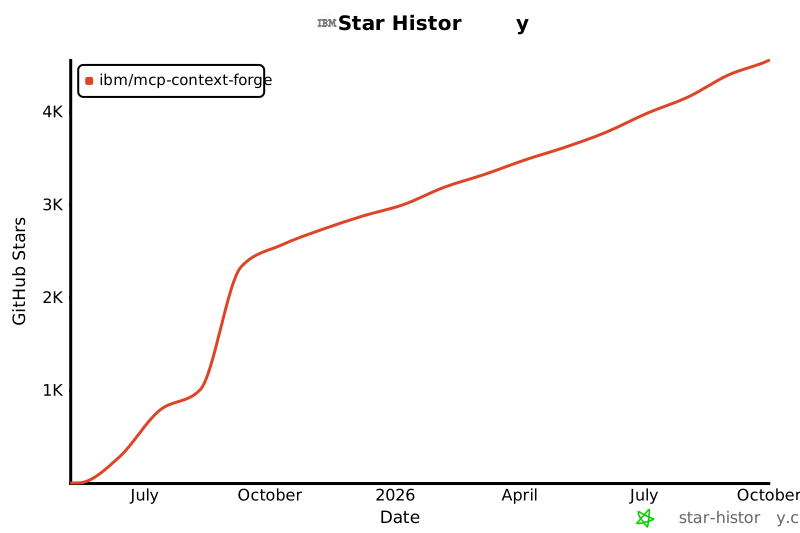
Star History and Project Activity