Azure DevOps MCP Server
A Model Context Protocol (MCP) server implementation for Azure DevOps, allowing AI assistants to interact with Azure DevOps APIs through a standardized protocol.
Looking for the official server? Microsoft maintains a product-supported Azure DevOps MCP at microsoft/azure-devops-mcp. If you use Azure DevOps Services (cloud), start there.
This community server remains a good fit when you need Azure DevOps Server (on-premises) support — especially older versions that may not work with Microsoft's MCP — or features not yet available in the official server. See Discussion #237 for more context. See ROADMAP.md for where this server differentiates and what is planned.
Overview
This server implements the Model Context Protocol (MCP) for Azure DevOps, enabling AI assistants like Claude to interact with Azure DevOps resources securely. The server acts as a bridge between AI models and Azure DevOps APIs, providing a standardized way to:
- Access and manage projects, work items, repositories, and more
- Create and update work items, branches, and pull requests
- Execute common DevOps workflows through natural language
- Access repository content via standardized resource URIs
- Safely authenticate and interact with Azure DevOps resources
Server Structure
The server is structured around the Model Context Protocol (MCP) for communicating with AI assistants. It provides tools for interacting with Azure DevOps resources including:
- Projects
- Work Items
- Repositories
- Pull Requests
- Branches
- Pipelines
Core Components
- AzureDevOpsServer: Main server class that initializes the MCP server and registers tools
- Feature Modules: Organized by feature area (work-items, projects, repositories, etc.)
- Request Handlers: Each feature module provides request identification and handling functions
- Tool Handlers: Modular functions for each Azure DevOps operation
- Configuration: Environment-based configuration for organization URL, PAT, etc.
The server uses a feature-based architecture where each feature area (like work-items, projects, repositories) is encapsulated in its own module. This makes the codebase more maintainable and easier to extend with new features.
Getting Started
Prerequisites
- Node.js (v16+)
- npm or yarn
- Azure DevOps account with appropriate access
- Authentication credentials (see Authentication Guide for details):
- Personal Access Token (PAT), or
- Azure Identity credentials, or
- Azure CLI login
Running from npm (npx)
If you just want to run the published server package, you do not need to clone or build this repository:
npx -y @tiberriver256/mcp-server-azure-devops
Running locally (from source)
From a checkout of this repository:
npm ci
cp .env.example .env   # then edit values
npm run build
npm start              # runs: node dist/index.js
For iterative development (auto-reload):
npm run dev # runs src/index.ts via ts-node-dev
Usage with Claude Desktop/Cursor AI
To integrate with Claude Desktop or Cursor AI, add one of the following configurations to your configuration file.
Azure Identity Authentication
Be sure you are logged in to Azure CLI with az login then add the following:
{
  "mcpServers": {
    "azureDevOps": {
      "command": "npx",
      "args": ["-y", "@tiberriver256/mcp-server-azure-devops"],
      "env": {
        "AZURE_DEVOPS_ORG_URL": "https://dev.azure.com/your-organization",
        "AZURE_DEVOPS_AUTH_METHOD": "azure-identity",
        "AZURE_DEVOPS_DEFAULT_PROJECT": "your-project-name"
      }
    }
  }
}
Personal Access Token (PAT) Authentication
{
  "mcpServers": {
    "azureDevOps": {
      "command": "npx",
      "args": ["-y", "@tiberriver256/mcp-server-azure-devops"],
      "env": {
        "AZURE_DEVOPS_ORG_URL": "https://dev.azure.com/your-organization",
        "AZURE_DEVOPS_AUTH_METHOD": "pat",
        "AZURE_DEVOPS_PAT": "<YOUR_PAT>",
        "AZURE_DEVOPS_DEFAULT_PROJECT": "your-project-name"
      }
    }
  }
}
Azure DevOps Server (on-prem) requires PAT authentication. Example:
{
  "mcpServers": {
    "azureDevOps": {
      "command": "npx",
      "args": ["-y", "@tiberriver256/mcp-server-azure-devops"],
      "env": {
        "AZURE_DEVOPS_ORG_URL": "https://server:8080/tfs/DefaultCollection",
        "AZURE_DEVOPS_AUTH_METHOD": "pat",
        "AZURE_DEVOPS_PAT": "<YOUR_PAT>",
        "AZURE_DEVOPS_DEFAULT_PROJECT": "your-project-name"
      }
    }
  }
}
For detailed configuration instructions and more authentication options, see the Authentication Guide.
Authentication Methods
This server supports multiple authentication methods for connecting to Azure DevOps APIs. For detailed setup instructions, configuration examples, and troubleshooting tips, see the Authentication Guide.
Supported Authentication Methods
- Personal Access Token (PAT) - Simple token-based authentication
- Azure Identity (DefaultAzureCredential) - Flexible authentication using the Azure Identity SDK
- Azure CLI - Authentication using your Azure CLI login
Example configuration files for each authentication method are available in the examples directory.
Azure DevOps Server (on-prem) supports PAT authentication only. Azure Identity and Azure CLI are supported for Azure DevOps Services.
Environment Variables
For a complete list of environment variables and their descriptions, see the Authentication Guide.
Key environment variables include:
Troubleshooting Authentication
For detailed troubleshooting information for each authentication method, see the Authentication Guide.
Common issues include:
- Invalid or expired credentials
- Insufficient permissions
- Network connectivity problems
- Configuration errors
Authentication Implementation Details
For technical details about how authentication is implemented in the Azure DevOps MCP server, see the Authentication Guide and the source code in the src/auth directory.
The Azure DevOps MCP server provides a variety of tools for interacting with Azure DevOps resources. For detailed documentation on each tool, please refer to the corresponding documentation.
get_me: Get details of the authenticated user (id, displayName, email) (Azure DevOps Services only)
list_organizations: List all accessible organizations (Azure DevOps Services only)
list_projects: List all projects in an organizationget_project: Get details of a specific projectget_project_details: Get comprehensive details of a project including process, work item types, and teams
list_repositories: List all repositories in a projectget_repository: Get details of a specific repositoryget_repository_details: Get detailed information about a repository including statistics and refsget_file_content: Get content of a file or directory from a repositoryget_repository_tree: List a repository's file tree from any path and depthcreate_branch: Create a new branch from an existing onecreate_commit: Commit multiple file changes to a branch using unified diffs or search/replace instructions
get_work_item: Retrieve a work item by IDcreate_work_item: Create a new work itemupdate_work_item: Update an existing work itemlist_work_items: List work items in a projectmanage_work_item_link: Add, remove, or update links between work itemscreate_work_item_attachment: Upload and attach a file to a work itemget_work_item_attachment: Download an attachment from a work itemdelete_work_item_attachment: Delete an attachment from a work item
search_code: Search for code across repositories in a projectsearch_wiki: Search for content across wiki pages in a projectsearch_work_items: Search for work items across projects in Azure DevOps
list_pipelines: List pipelines in a projectget_pipeline: Get details of a specific pipelinelist_pipeline_runs: List recent runs for a pipeline with optional filtersget_pipeline_run: Get detailed run information and artifact summariesdownload_pipeline_artifact: Download a single artifact file as textpipeline_timeline: Retrieve the stage and job timeline for a runget_pipeline_log: Retrieve raw or JSON-formatted log contenttrigger_pipeline: Trigger a pipeline run with customizable parameters
get_wikis: List all wikis in a projectget_wiki_page: Get content of a specific wiki page as plain text
For comprehensive documentation on all tools, see the Tools Documentation.
Contributing
Contributions are welcome! Please see CONTRIBUTING.md for contribution guidelines.
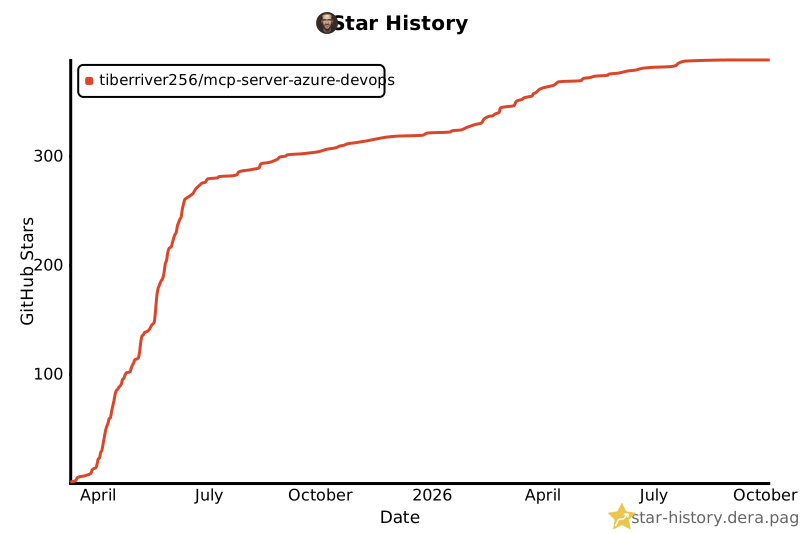
Star History
License
MIT