mcp-probe-kit — Know the Context, Feed the Moment
知时MCP | mcp-probe-kit
Know the Context, Feed the Moment.
Introspection · Context Hydration · Delegated Orchestration
Talk is cheap, show me the Context.
mcp-probe-kit is a protocol-level toolkit designed for developers who want AI to understand project intent, choose a precise workflow, and retain validated experience without flooding the model with internal actions.
Languages: English | 简体中文 | 日本語 | 한국어 | Español | Français | Deutsch | Português (BR)




🚀 AI-Powered Complete Development Toolkit - Covering the Entire Development Lifecycle
A powerful MCP (Model Context Protocol) server with 24 model-visible tools by default, 30 when Memory is configured, and a 34-tool compatibility surface available through MCP_TOOLSET=full. It covers the complete workflow from product analysis to final release and supports structured output.
🎉 v4 stable release: native MCP Apps, resumable plans, evidence convergence, managed GitNexus Sidecar, parent-child specs, and a version-locked CLI fallback.
Supports All MCP Clients: Cursor, Claude Desktop, Cline, Continue, and more
Protocol Support: Legacy MCP (2025-era) + Modern MCP 2026-07-28 · SDK: split TypeScript SDK v2 packages
Runtime: Node.js 20 or newer. MCP_PROTOCOL_MODE=auto is the default; use legacy or modern only for compatibility diagnosis.
🎬 v4 in action
v4 turns delegated Agent work into an observable and verifiable delivery loop. The animations below are rendered from the same MCP App source shipped in the npm package—not separate marketing mockups.
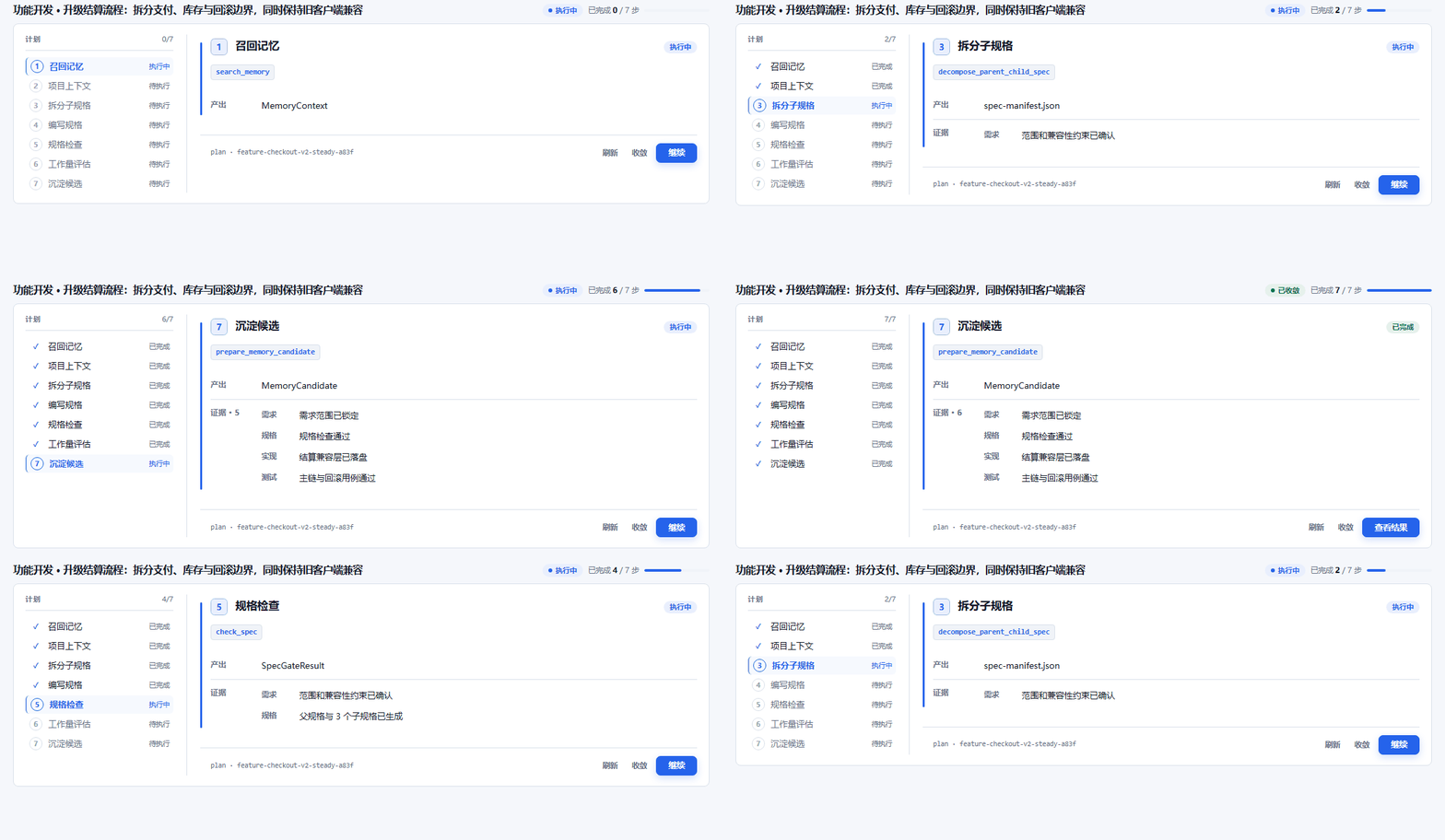
Feature Workbench — parent-child specs, active step, outputs, evidence, and cross-session recovery.
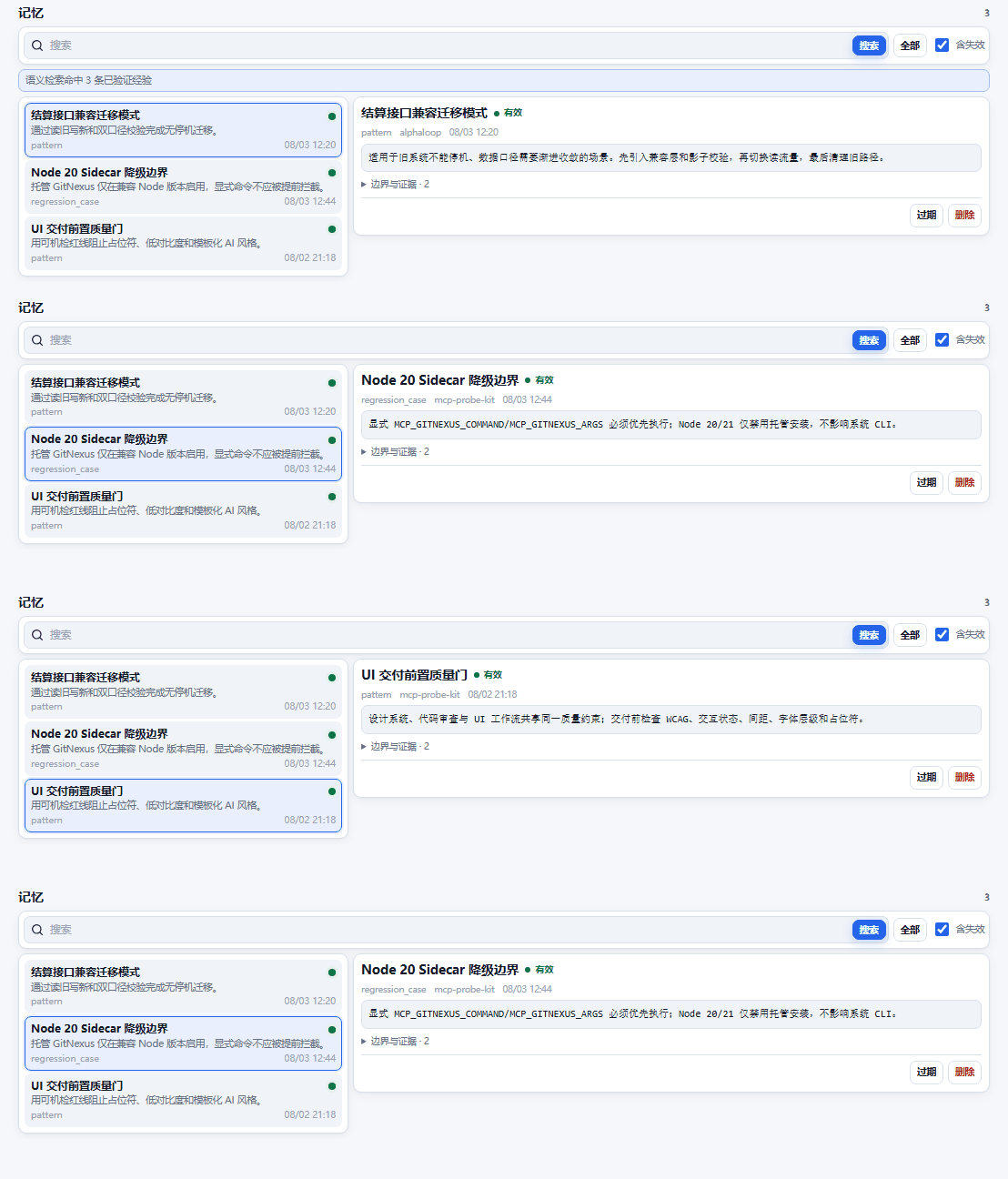
Memory Center — semantic search, full-content inspection, lifecycle state, evidence, stale marking, and confirmed deletion.
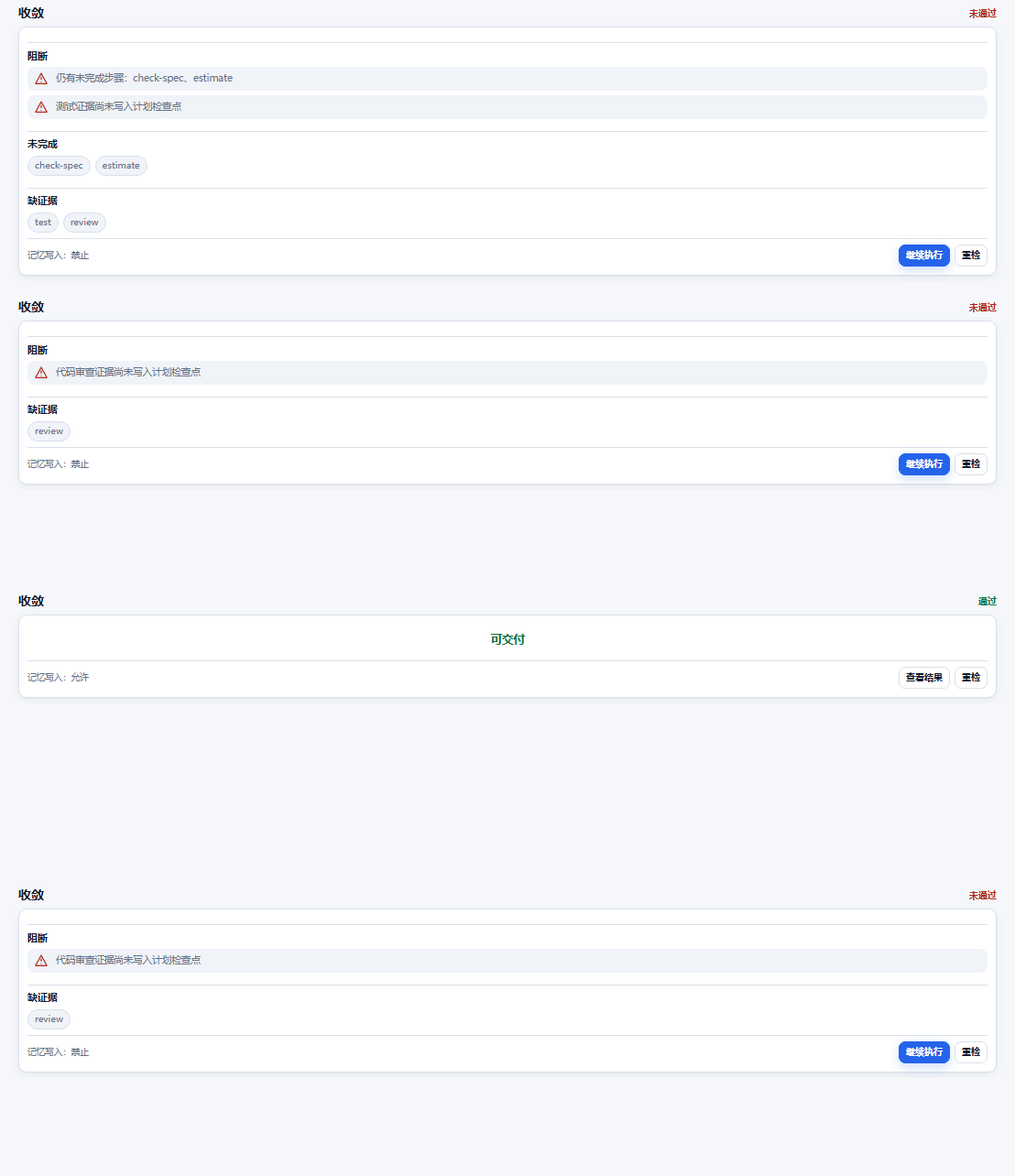
Convergence Gate — blocks closure when steps or requirements/spec/implementation/test/review evidence are incomplete.
- Five native MCP Apps: Memory Center, Feature Workbench, Bug Workbench, Product Workbench, and Convergence Gate.
- Resumable delegated plans:
plan_heartbeat persists real progress; resume_plan restores the next executable step.
- Evidence-based convergence:
converge gates delivery and long-term Memory writes.
- Managed GitNexus Sidecar: version/platform/architecture/Node isolation, integrity verification, real FTS probe, and safe degradation.
- Version-locked CLI fallback: project-local
probe wrappers reach the same Tool Registry when a host drops the MCP tool lease.
- Parent-child specifications: complex releases are decomposed and recursively validated instead of being flattened into one oversized spec.
Open the five live, read-only MCP App demos
v4 stable: [email protected] is the current stable release and npm latest channel.
📚 Complete Documentation
👉 https://mcp-probe-kit.bytezonex.com
- Quick Start - Setup in 5 minutes
- Local Memory Stack (Qdrant + Nomic Embed) - Docker Compose, ports
50008 / 50012, MCP env
- All Tools - Default, conditional Memory, App-only, and full compatibility surfaces
- Best Practices - Full development workflow guide
- v3 → v4 Migration Guide - Tool surfaces, protocol, Apps, plan state, Memory, and compatibility
- MCP Apps Live Demos - Five real read-only workbenches generated from the shipped App source
✨ Core Features
The default compact surface keeps every independently useful workflow while removing competing internal and maintenance entries from the model context.
- 🧭 Routing (1) —
workflow
- 🔁 Plan State & Convergence (3) —
plan_heartbeat, resume_plan, converge
- 🔄 Workflow Orchestration (6) —
start_feature, start_bugfix, start_onboard, start_ui, start_product, start_ralph
- 📦 Project & Specification (4) —
init_project, init_project_context, check_spec, estimate
- 🏗️ Architecture (1) —
architecture
- 🔍 Code, Test & Git (6) —
code_insight, gentest, code_review, refactor, gencommit, git_work_report
- 🎨 UI/UX Utilities (2) —
ui_design_system, ui_search
- 🗣️ Structured Interview (1) —
interview
That is 24 model-visible tools by default. When the full Memory stack is configured, six Memory tools are added dynamically, bringing the model-visible surface to 30:
search_memory, read_memory_asset, memorize_asset, update_memory_asset, delete_memory_asset, scan_and_extract_patterns
For compatibility and diagnostics, MCP_TOOLSET=full restores all 34 model tools. The compact surface deliberately omits add_feature, fix_bug, sync_ui_data, and ask_user: their implementations remain available through orchestration, maintenance scripts, or full compatibility mode.
workflow is a fallback tool-selection guide, not a natural-language intent classifier. The Agent normally chooses the appropriate MCP tool directly from the current conversation, Skill, and tool descriptions. scenario=auto returns guidance only (firstTool=null); an explicit scenario returns deterministic guidance for a scenario the Agent has already selected.
🔁 Delegated Plan State, Recovery, and Convergence
- Every v4 delegated plan declares
executionStatePolicy and instructs the Agent to create a local checkpoint on the first step.
plan_heartbeat persists completed/skipped steps, unresolved items, evidence, and the last verified revision under .mcp-probe-kit/plans/.resume_plan recalculates ready and blocked steps from stored dependencies after interruption, restart, or Agent handoff.converge refuses closure while steps, unresolved items, or requirements/spec/implementation/test/review evidence are incomplete. Formal long-term memory writes are allowed only after convergence passes.- These tools track and validate Agent execution; they do not move file, shell, Git, or implementation work into the MCP server.
🛡️ Quality Constraints (single source of truth)
All hard quality rules live in one module (src/lib/quality-constraints.ts) and are injected into code_review, the add_feature task templates, and the UI tools. Change once, apply everywhere — inspired by taste-skill and impeccable.
- Code limits: single file ≤ 500 lines (split into modules/components when exceeded), function ≤ 50 lines, nesting ≤ 4, parameters ≤ 3.
- Completeness blacklist:
code_review flags placeholder/elision patterns (// ..., // TODO, // rest of code, bare ...) as CRITICAL — "a partial output is a broken output".
- Anti-laziness task templates:
add_feature tasks now carry a Scope-lock deliverable count, a mandatory evidence block (read code before writing), a per-file line budget, and a binary zero-tolerance rule for placeholders. check_spec validates these (missing Scope-lock = error, thin task without evidence = warning).
- UI hard red lines: numeric, machine-checkable rules — 4pt spacing scale, WCAG contrast (4.5/3/3), type scale ≥ 1.25, hero font ≤ 6rem, OKLCH, eight interaction states, cognitive load ≤ 4, motion 150-300ms.
- UI banned list + Pre-Flight checklist: match-and-refuse blacklist for AI slop (default Inter/Roboto, AI purple-blue gradients, gradient text, cookie-cutter card grids, em-dash, cream/beige body backgrounds, nested cards) plus a delivery-gate self-check matrix.
🧠 Code Graph Bridge (GitNexus)
code_insight bridges GitNexus by default for query/context/impact analysis- The bridge prefers an explicitly configured or system GitNexus CLI, then a version-locked managed Sidecar; GitNexus is not bundled into the main package and is never globally installed
init_project_context bootstraps baseline graph docs under docs/graph-insights/; if docs/project-context.md already exists, it preserves the old context docs and only backfills graph docs plus the index entrystart_feature refreshes the GitNexus index and runs task-level query/context/impact narrowing before spec generation to reduce over-scopingstart_bugfix refreshes the GitNexus index and runs task-level graph analysis before TBP RCA to constrain failure boundary and blast radius- Older projects that already have
project-context.md but no graph docs are bootstrapped automatically through the init_project_context step
- If GitNexus is unavailable, the server falls back automatically without breaking orchestration
- Real graph queries read the
.gitnexus index; docs/graph-insights/latest.md|json are readable snapshots for humans and AI agents
- MCP resources in MCP client settings list 2 entries (
probe://status, probe://project/bootstrap). Graph runtime snapshots (probe://graph/latest, etc.) and probe://project/skill|agents|context|graph remain readable via resources/read when tools expose URIs
- Graph snapshots are persisted to
.mcp-probe-kit/graph-snapshots (customizable via MCP_GRAPH_SNAPSHOT_DIR)
- Tool responses include
_meta.graph with snapshot URI and local JSON/Markdown file paths
🐛 SRC-8 Bug Root-Cause Workflow (TBP-Inspired)
- SRC-8 Methodology (中文: src8-methodology.zh-CN.md) — Software Root-Cause 8-step protocol inspired by Toyota TBP / PDCA, adapted for code and AI agents
start_bugfix runs graph narrowing, then delegated SRC-8 plan (metadata.plan.steps src8-1~8) before repair and testsfix_bug returns delegated plan (src8-1~8), src8Checklist, rootCauseWorksheet (Step 4 core), and hard gates (no code change until root-cause worksheet is closed)- Highlights vs manufacturing TBP: repro contract, attribution layers (including
agent_behavior), contributing factors, memorize_asset for cross-repo learning
Inherited from Toyota TBP: gap thinking, Plan-before-Do, no skipping to root-cause analysis, fact-based investigation, countermeasures over symptoms, evaluate then standardize.
Our elevation: genchi-genbutsu → read code/logs/repro; Step 4 worksheet; guidance-only MCP that forces discipline while the Agent executes.
🧠 Memory Retrieval
- Memory tools use Qdrant as the vector database backend
- Embedding service supports two modes:
Memory tools:
search_memory - Semantic search across the shared memory pool (optionally prefer type / tags); text output includes id, score, summary, description, and a --- content --- body (default up to 1500 chars via MEMORY_SEARCH_CONTENT_MAX_CHARS)memorize_asset - Persist an already validated MemoryCandidate into vector memory; for delegated workflows, call it only after converge passesread_memory_asset - Read full asset content by asset_id (text output includes the full content body)update_memory_asset - Update an existing asset by asset_id (preserves ID; content changes re-embed)delete_memory_asset - Delete an asset by asset_id from the shared poolscan_and_extract_patterns - Extract reusable patterns from code/file/directory before deciding whether to persist
Cross-repo memory pools: do not rely on source_project / source_path for shared retrieval; put file paths in content instead. Search injection hides foreign sourcePath unless MEMORY_REPO_ID matches or MEMORY_SEARCH_SHOW_SOURCE=true.
Memory backend and embedding configuration:
- Vector database: Qdrant
- Recommended local setup:
Qdrant (port 50008) + Infinity / nomic-embed (port 50012) — lighter than Ollama; see Local Memory Stack guide (中文: memory-local-setup.zh-CN.md)
- Supported embedding providers:
ollamaopenai-compatible (Infinity, OpenAI, etc.)
- Required environment variables for memory write/search:
MEMORY_QDRANT_URLMEMORY_EMBEDDING_URLMEMORY_EMBEDDING_MODEL
- Optional environment variables:
MEMORY_QDRANT_API_KEYMEMORY_QDRANT_COLLECTION (default: mcp_probe_memory)MEMORY_EMBEDDING_API_KEYMEMORY_EMBEDDING_PROVIDER (ollama by default)MEMORY_SEARCH_LIMIT (default: 3)MEMORY_SUMMARY_MAX_CHARS (default: 280)MEMORY_SEARCH_MIN_SCORE (default: 0 = disabled; try 0.72 for noisy pools)MEMORY_SEARCH_SHOW_SOURCE (default: false)MEMORY_REPO_ID (optional; show sourcePath only when sourceProject matches)MEMORY_INJECTION_CONTENT_MAX_CHARS (default: 1500; max content per hit injected into start_* guides)
- Behavior notes:
- Read-only memory access only requires
MEMORY_QDRANT_URL
- Memory write is enabled only when
MEMORY_QDRANT_URL, MEMORY_EMBEDDING_URL, and MEMORY_EMBEDDING_MODEL are all configured
- The Qdrant collection is auto-created on first write, and vector dimension is inferred from the first embedding response
Recommended local memory setup (Qdrant + Nomic Embed / Infinity):
Full Docker Compose, ports, and troubleshooting: docs/memory-local-setup.md
{
  "mcpServers": {
    "mcp-probe-kit": {
      "command": "npx",
      "args": ["-y", "[email protected]"],
      "env": {
        "MEMORY_QDRANT_URL": "http://127.0.0.1:50008",
        "MEMORY_QDRANT_API_KEY": "your-qdrant-api-key",
        "MEMORY_QDRANT_COLLECTION": "mcp_probe_memory",
        "MEMORY_EMBEDDING_PROVIDER": "openai-compatible",
        "MEMORY_EMBEDDING_URL": "http://127.0.0.1:50012/embeddings",
        "MEMORY_EMBEDDING_MODEL": "nomic-ai/nomic-embed-text-v1.5",
        "MEMORY_EMBEDDING_API_KEY": "your-infinity-api-key",
        "MEMORY_SEARCH_LIMIT": "3",
        "MEMORY_SUMMARY_MAX_CHARS": "280"
      }
    }
  }
}
Alternative: Qdrant + Ollama (if you already run Ollama):
docker run -d --name mcp-qdrant -p 6333:6333 qdrant/qdrant
ollama pull nomic-embed-text
"MEMORY_QDRANT_URL": "http://127.0.0.1:6333",
"MEMORY_EMBEDDING_PROVIDER": "ollama",
"MEMORY_EMBEDDING_URL": "http://127.0.0.1:11434/api/embeddings",
"MEMORY_EMBEDDING_MODEL": "nomic-embed-text"
OpenAI-compatible embedding (hosted API):
{
  "mcpServers": {
    "mcp-probe-kit": {
      "command": "npx",
      "args": ["-y", "[email protected]"],
      "env": {
        "MEMORY_QDRANT_URL": "http://127.0.0.1:6333",
        "MEMORY_QDRANT_COLLECTION": "mcp_probe_memory",
        "MEMORY_EMBEDDING_PROVIDER": "openai-compatible",
        "MEMORY_EMBEDDING_URL": "https://your-embedding-endpoint/v1/embeddings",
        "MEMORY_EMBEDDING_API_KEY": "your-api-key",
        "MEMORY_EMBEDDING_MODEL": "text-embedding-3-small"
      }
    }
  }
}
🎯 Structured Output
Core and orchestration tools support structured output, returning machine-readable JSON data, improving AI parsing accuracy, supporting tool chaining and state tracking.
⏱️ Native Tasks, Progress, and Cancellation
- Uses an SDK-independent Internal Task Runtime, with the current SDK task protocol exposed through a Legacy Adapter
- Supports task lifecycle endpoints:
tasks/get, tasks/result, tasks/list, tasks/cancel
- Advertises
capabilities.tasks.requests.tools.call so clients can create tasks for tools/call
- Falls back to synchronous execution when protocol task storage is unavailable
- Emits
notifications/progress when client provides _meta.progressToken
- Ignores late progress after terminal completion; tool/task result is the final completion signal
- Handles request cancellation via
AbortSignal and preserves a clear cancelled state
- Long-running orchestration tools (
start_*) and sync_ui_data support cooperative cancellation/progress callbacks
- Internal task persistence defaults to memory. Set
MCP_TASK_STORE=json to use .mcp-probe-kit/tasks.json, or set MCP_TASK_STORE_PATH to choose another JSON path. Interrupted tasks that cannot reconstruct their executor are explicitly marked failed on restart instead of being reported as still running.
🔌 Official MCP Apps and Memory Center
v4.0.0 uses the official @modelcontextprotocol/ext-apps SDK and the stable io.modelcontextprotocol/ui extension.
- MCP Apps are enabled by default and can be disabled with
MCP_ENABLE_UI_APPS=0.
- UI metadata and
ui:// resources are exposed only after the client advertises support for text/html;profile=mcp-app.
- Five stable Apps are included: Memory Center, Feature Workbench, Bug Workbench, Product Workbench, and Convergence Gate.
- Memory Center uses a responsive master-detail layout for historical browsing, semantic search, full-content inspection, lifecycle state, evidence, stale marking, and confirmed deletion.
- Feature and Bug Workbenches render a live plan stepper. The App polls
resume_plan while visible, and progress advances only after the Agent records real step state through plan_heartbeat.
- Product Workbench and Convergence Gate use the same developer-console design system for delivery paths, blockers, and evidence gaps.
list_memory_assets is an App-only action with _meta.ui.visibility=["app"]. It may appear in the raw tools/list response of an Apps-capable host, but compliant hosts must not offer it to the model. The model-visible count remains 24 by default or 30 with Memory.- Clients without MCP Apps support continue to receive the normal text and
structuredContent responses; no GUI capability is required for existing workflows.
- Trace metadata passthrough remains available through
MCP_ENABLE_EXTENSIONS_CAPABILITY=1.
# Deterministic server-side audit across compact, Memory, full, App-only, and Legacy surfaces
npm run audit:tools

# Optional real-host audit: Claude Code calls and evaluates all 34 model tools
npm run audit:tools:agent
The direct audit verifies non-empty readable text, structuredContent, and that every referenced MCP tool exists on the active surface. The real-Agent audit additionally checks whether an Agent understands each tool, can follow the returned guidance, sees no text/structured contradiction, and can execute the stated next step. It is intentionally separate from release:verify because it requires a configured Claude Code account and incurs model usage.
🧭 Delegated Orchestration Protocol
All start_* orchestration tools return an execution plan in structuredContent.metadata.plan.
AI needs to call tools step by step and persist files, rather than the tool executing internally.
Plan Schema (Core Fields):
{
  "mode": "delegated",
  "steps": [
    {
      "id": "spec",
      "tool": "add_feature",
      "args": { "feature_name": "user-auth", "description": "User authentication feature" },
      "outputs": ["docs/specs/user-auth/requirements.md"]
    }
  ]
}
Field Description:
mode: Fixed as delegatedsteps: Array of execution stepstool: Tool name (e.g. add_feature)action: Manual action description when no tool (e.g. update_project_context)args: Tool parametersoutputs: Expected artifactswhen/dependsOn/note: Optional conditions and notes
🧩 Structured Output Field Specification (Key Fields)
Both orchestration and atomic tools return structuredContent, common fields:
summary: One-line summarystatus: Status (pending/success/failed/partial)steps: Execution steps (orchestration tools)artifacts: Artifact list (path + purpose)metadata.plan: Delegated execution plan (only start_*)specArtifacts: Specification artifacts (start_feature)estimate: Estimation results (start_feature / estimate)
🧠 Requirements Clarification Mode (Requirements Loop)
When requirements are unclear, use requirements_mode=loop in start_feature / start_bugfix / start_ui.
This mode performs 1-2 rounds of structured clarification before entering spec/fix/UI execution.
Example:
{
  "feature_name": "user-auth",
  "description": "User authentication feature",
  "requirements_mode": "loop",
  "loop_max_rounds": 2,
  "loop_question_budget": 5
}
🧩 Template System (Regular Model Friendly)
add_feature supports template profiles, default auto auto-selects: prefers guided when requirements are incomplete (includes detailed filling rules and checklists), selects strict when requirements are complete (more compact structure, suitable for high-capability models or archival scenarios).
Example:
{
  "description": "Add user authentication feature",
  "template_profile": "auto"
}
Applicable Tools:
start_feature passes template_profile to add_featurestart_bugfix / start_ui also support template_profile for controlling guidance strength (auto/guided/strict)
Template Profile Strategy:
guided: Less/incomplete requirements info, regular model prioritystrict: Requirements structured, prefer more compact guidanceauto: Default recommendation, auto-selects guided/strict
Parent-Child Specifications
For version-level or epic work, start_feature defaults to spec_layout: "auto" and selects parent-child when the requirement spans multiple modules, stages, or capability domains. If child boundaries are not known yet, the delegated plan first returns a decompose-spec step. You can still explicitly pass flat or parent-child; add_feature remains an atomic tool and defaults to flat unless the layout and subspecs are already defined. The MCP server returns templates and pendingFiles; the calling Agent creates the parent spec, spec-manifest.json, and child specs after review. check_spec then validates the complete hierarchy recursively.
start_feature uses query-only GitNexus narrowing with an 8-second degradation budget, so graph cold starts do not block specification planning. Automatic index refresh is disabled by default; set MCP_GITNEXUS_AUTO_REFRESH=1 when the MCP process should refresh the index before graph queries.
{
  "feature_name": "commerce-v2",
  "description": "Upgrade the commerce domain while preserving v1 compatibility",
  "spec_layout": "parent-child",
  "subspecs": [
    { "id": "01-foundation", "title": "Data foundation", "fr": ["FR-1"] },
    { "id": "06-inventory-ledger", "title": "Inventory ledger", "fr": ["FR-2"], "dependsOn": ["01-foundation"] }
  ]
}
🔄 Workflow Orchestration
6 intelligent orchestration tools that automatically combine multiple basic tools for one-click complex development workflows:
start_feature - New feature development (Requirements → Design → Estimation)start_bugfix - Bug fixing (SRC-8 RCA → Fix → Testing)start_onboard - Project onboarding (Generate project context docs)start_ui - UI development (Design system → Components → Code)start_product - Product design (PRD → Prototype → Design system → HTML)start_ralph - Ralph Loop (Iterative development until goal completion)
🚀 Product Design Workflow
start_product is a complete product design orchestration tool, from requirements to interactive prototype:
Workflow:
- Requirements Analysis - Generate standard PRD (product overview, feature requirements, page list)
- Prototype Design - Generate detailed prototype docs for each page
- Design System - Generate design specifications based on product type
- HTML Prototype - Generate interactive prototype viewable in browser
- Project Context - Auto-update project documentation
Structured Output Additions:
start_product.structuredContent.artifacts: Artifact list (PRD, prototypes, design system, etc.)interview.structuredContent.mode: usage / questions / record
🎨 UI/UX Pro Max
4 UI/UX tools with start_ui as the unified entry point:
start_ui - One-click UI development (supports intelligent mode) (orchestration tool)ui_design_system - Intelligent design system generationui_search - UI/UX data search (BM25 algorithm)sync_ui_data - Sync latest UI/UX data locally
Note: start_ui automatically calls ui_design_system and ui_search, you don't need to call them separately.
Inspiration:
Skill Bridge for UI/PRD workflows:
start_ui and start_product now include a Skill Bridge section in guidance and structuredContent.metadata.skills.- Recommended skill call order:
ui-ux-pro-max → interaction-design → frontend-design.
- If some skills are missing, workflow continues with MCP main plan and marks unavailable skills in metadata.
Why use sync_ui_data?
Our start_ui tool relies on a rich UI/UX database (colors, icons, charts, components, design patterns, etc.) to generate high-quality design systems and code. This data comes from npm package uipro-cli, including:
- 🎨 Color schemes (mainstream brand colors, color palettes)
- 🔣 Icon libraries (React Icons, Heroicons, etc.)
- 📊 Chart components (Recharts, Chart.js, etc.)
- 🎯 Landing page templates (SaaS, e-commerce, government, etc.)
- 📐 Design specifications (spacing, fonts, shadows, etc.)
Data Sync Strategy:
- Embedded Data: Synced at build time, works offline
- Background Auto Sync: Downloads latest data to
~/.mcp-probe-kit/ui-ux-data/ without changing current session output
- Next-Start Activation: Newly downloaded data is applied on next process start (keeps current session deterministic)
- Manual Sync: Use
sync_ui_data to force refresh cache immediately (still applies next start by default)
This ensures start_ui can generate professional-grade UI code even offline.
🎤 Requirements Interview
2 interview tools to clarify requirements before development:
interview - Structured requirements interviewask_user - AI proactive questioning
Use orchestration tools (start_*) when:
- ✅ Need complete workflow (multiple steps)
- ✅ Want to automate multiple tasks
- ✅ Need to generate multiple artifacts (docs, code, tests, etc.)
Use individual tools when:
- ✅ Only need specific functionality
- ✅ Already have project context docs
- ✅ Need more fine-grained control
Common Scenario Selection
🚀 Quick Start
Method 1: Use directly with npx (Recommended)
No installation needed, use the latest version directly.
Cursor / Cline Configuration
Config file location:
- Windows:
%APPDATA%\Cursor\User\globalStorage\saoudrizwan.claude-dev\settings\cline_mcp_settings.json
- macOS:
~/Library/Application Support/Cursor/User/globalStorage/saoudrizwan.claude-dev/settings/cline_mcp_settings.json
- Linux:
~/.config/Cursor/User/globalStorage/saoudrizwan.claude-dev/settings/cline_mcp_settings.json
Config content:
{
  "mcpServers": {
    "mcp-probe-kit": {
      "command": "npx",
      "args": ["-y", "[email protected]"]
    }
  }
}
Skill & AGENTS auto-bootstrap (v3.6.3+): Every MCP tool call writes .agents/skills/mcp-probe-kit/SKILL.md and merges the mcp-probe:context block into AGENTS.md. Workspace root is auto-detected (Cursor injects WORKSPACE_FOLDER_PATHS; OpenCode project opencode.json sets cwd). No per-client MCP_PROJECT_ROOT unless global MCP cannot resolve the workspace — then set MCP_PROJECT_ROOT or pass project_root in tool args.
Multi-harness adapters (v3.6.8+): AGENTS.md and the canonical Skill stay the single rule source. If the project already has .trae/, .lingma/, .comate/, .codebuddy/, or .claude/, matching thin adapters (skill mirror or rules pointer) are written automatically — no env vars.
Version-locked CLI fallback (v4.0.0+): Bootstrap also writes .mcp-probe-kit/bin/probe.cmd|probe.ps1|probe and .mcp-probe-kit/runtime.json. If a modified host or third-party Agent provider connects the MCP server but omits its tools from the Agent session, the generated Skill and Cursor rule instruct the Agent to invoke the same Tool Registry through the project wrapper. The wrapper pins the exact MCP package version, does not install globally, and does not modify the project's package.json.
Memory for CLI fallback: install-agent also creates .mcp-probe-kit/local.env (and local.env.example). The CLI fallback path (probe.* exec ...) does not inherit IDE mcp.json env; edit local.env with the same MEMORY_* keys.
Direct CLI examples:
# JSON from stdin is the most portable option
printf '%s' '{"intent":"build a task board","scenario":"feature","project_root":"."}' \
  | ./.mcp-probe-kit/bin/probe exec workflow --stdin

# Repair or install the project wrappers without a working MCP tool lease
npx --yes mcp-probe-kit@<exact-version> install-agent --project-root .
Claude Desktop Configuration
Config file location:
- Windows:
%APPDATA%\Claude\claude_desktop_config.json
- macOS:
~/Library/Application Support/Claude/claude_desktop_config.json
- Linux:
~/.config/Claude/claude_desktop_config.json
Config content:
{
  "mcpServers": {
    "mcp-probe-kit": {
      "command": "npx",
      "args": ["-y", "[email protected]"]
    }
  }
}
OpenCode Configuration
Config file location:
- Project-level:
opencode.json (in project root)
- Global:
~/.config/opencode/opencode.json
Config content:
{
  "mcp": {
    "mcp-probe-kit": {
      "type": "local",
      "command": ["npx", "-y", "[email protected]"],
      "enabled": true
    }
  }
}
Note: OpenCode uses opencode.json with a different schema from Cursor/Claude Desktop. The key mcp replaces mcpServers, command is an array, type: "local" is required, and environment variables use environment instead of env. See OpenCode MCP docs for details.
Method 2: Project-local Agent fallback
npx --yes [email protected] install-agent --project-root .
This writes version-locked .mcp-probe-kit/bin/probe.* launchers. Prefer native MCP; when the host does not inject tools, the Agent uses these wrappers. Do not install the package globally.
Optional Memory System Setup
If you want to use memorize_asset, update_memory_asset, read_memory_asset, delete_memory_asset, and scan_and_extract_patterns, configure as follows:
- Qdrant only (
MEMORY_QDRANT_URL): read_memory_asset, delete_memory_asset
- Qdrant + embedding (all three
MEMORY_* write/search vars): search_memory, memorize_asset, update_memory_asset
- No memory backend:
scan_and_extract_patterns (local scan only; persist via memorize_asset when ready)
For full write/search you need both:
- A Qdrant vector database
- An embedding service in either
ollama or openai-compatible mode
Note (CLI fallback): If you run the project wrapper (./.mcp-probe-kit/bin/probe* exec ...) instead of native MCP, Memory env is read from .mcp-probe-kit/local.env (created by install-agent).
Full guide (Docker Compose for Qdrant + Infinity, ports 50008 / 50012, MCP env, smoke tests):
Option A: Qdrant + Nomic Embed / Infinity (recommended)
Lightweight local stack; no Ollama. Deploy Qdrant and nomic-embed via Docker Compose (see guide), then:
{
  "mcpServers": {
    "mcp-probe-kit": {
      "command": "npx",
      "args": ["-y", "[email protected]"],
      "env": {
        "MEMORY_QDRANT_URL": "http://127.0.0.1:50008",
        "MEMORY_QDRANT_API_KEY": "your-qdrant-api-key",
        "MEMORY_QDRANT_COLLECTION": "mcp_probe_memory",
        "MEMORY_EMBEDDING_PROVIDER": "openai-compatible",
        "MEMORY_EMBEDDING_URL": "http://127.0.0.1:50012/embeddings",
        "MEMORY_EMBEDDING_MODEL": "nomic-ai/nomic-embed-text-v1.5",
        "MEMORY_EMBEDDING_API_KEY": "your-infinity-api-key",
        "MEMORY_SEARCH_LIMIT": "3",
        "MEMORY_SUMMARY_MAX_CHARS": "280"
      }
    }
  }
}
Embedding URL must be /embeddings (not /v1/embeddings). Qdrant requires api-key when QDRANT__SERVICE__API_KEY is set.
Option B: Qdrant + Ollama
docker run -d --name mcp-qdrant -p 6333:6333 qdrant/qdrant
ollama pull nomic-embed-text
"MEMORY_QDRANT_URL": "http://127.0.0.1:6333",
"MEMORY_EMBEDDING_PROVIDER": "ollama",
"MEMORY_EMBEDDING_URL": "http://127.0.0.1:11434/api/embeddings",
"MEMORY_EMBEDDING_MODEL": "nomic-embed-text"
Option C: Qdrant + hosted OpenAI-compatible API
"MEMORY_QDRANT_URL": "http://127.0.0.1:50008",
"MEMORY_EMBEDDING_PROVIDER": "openai-compatible",
"MEMORY_EMBEDDING_URL": "https://your-embedding-endpoint/v1/embeddings",
"MEMORY_EMBEDDING_API_KEY": "your-api-key",
"MEMORY_EMBEDDING_MODEL": "text-embedding-3-small"
Memory Environment Variables
MEMORY_QDRANT_URL: Qdrant base URL, required for all memory featuresMEMORY_QDRANT_API_KEY: Optional Qdrant API keyMEMORY_QDRANT_COLLECTION: Collection name, default mcp_probe_memoryMEMORY_EMBEDDING_PROVIDER: ollama or openai-compatibleMEMORY_EMBEDDING_URL: Embedding endpoint URLMEMORY_EMBEDDING_API_KEY: Optional for Ollama, usually required for hosted OpenAI-compatible providersMEMORY_EMBEDDING_MODEL: Default is nomic-embed-textMEMORY_SEARCH_LIMIT: Default search result count is 3MEMORY_SUMMARY_MAX_CHARS: Default summary truncation length is 280
Notes
- Memory write capability is enabled only when
MEMORY_QDRANT_URL, MEMORY_EMBEDDING_URL, and MEMORY_EMBEDDING_MODEL are configured
- Memory read capability only requires
MEMORY_QDRANT_URL
- Qdrant collections are auto-created on first write with
Cosine distance
- Vector size is inferred from the first embedding response
GitNexus Managed Runtime
Applies to code_insight, start_feature, start_bugfix, and init_project_context.
GitNexus is not bundled into the mcp-probe-kit npm tarball because it includes native, platform-specific dependencies and uses the PolyForm Noncommercial license. The runtime policy is:
- Use
MCP_GITNEXUS_COMMAND when explicitly configured.
- Otherwise reuse an already validated managed Sidecar from the mcp-probe-kit user cache.
- Otherwise use a compatible
gitnexus CLI already available on PATH.
- If no runtime is installed, graph analysis degrades immediately instead of blocking the main workflow. The Agent can run
doctor gitnexus --install and retry automatically.
Validated compatibility:
Each managed installation is isolated by GitNexus version, operating system, CPU architecture, and Node.js major version. npm integrity is checked against the pinned release metadata before the runtime is accepted. The installer then runs gitnexus doctor plus a real TypeScript indexing probe and rejects any runtime that silently disables FTS/BM25 search.
Install or repair the managed Sidecar through the project launcher:
# Windows
& ./.mcp-probe-kit/bin/probe.cmd doctor gitnexus --install
# macOS / Linux
./.mcp-probe-kit/bin/probe doctor gitnexus --install
The first installation can take several minutes because GitNexus includes native parsers, LadybugDB, ONNX Runtime, and post-install grammar builds. It runs outside the project and does not modify the project package.json or node_modules.
Available modes:
MCP_GITNEXUS_MODE=auto — default; explicit/system/existing managed runtime, otherwise fast degradation.MCP_GITNEXUS_MODE=managed — require the managed Sidecar and allow installation during the graph request.MCP_GITNEXUS_MODE=system — use only explicit/system GitNexus; never install.MCP_GITNEXUS_MODE=off — disable GitNexus.MCP_GITNEXUS_AUTO_INSTALL=1 — allow auto mode to install synchronously; not recommended for latency-sensitive clients.
Some GitNexus dependencies use native modules. On Windows, LadybugDB FTS also requires the OpenSSL runtime shipped with Git for Windows; mcp-probe-kit discovers its mingw64/bin directory and exposes it only to the managed child process. Set MCP_GITNEXUS_WINDOWS_RUNTIME_BIN to an equivalent directory when Git is installed in a nonstandard location. A failed prebuilt-binary download may still require Visual Studio Build Tools with the C++ workload. Installation failure never prevents the mcp-probe-kit workflow from continuing in degraded mode.
Example config using a preinstalled gitnexus CLI:
{
  "mcpServers": {
    "mcp-probe-kit": {
      "command": "mcp-probe-kit",
      "env": {
        "MCP_GITNEXUS_MODE": "system",
        "MCP_GITNEXUS_COMMAND": "gitnexus",
        "MCP_GITNEXUS_ARGS": "mcp",
        "MCP_GITNEXUS_CONNECT_TIMEOUT_MS": "30000",
        "MCP_GITNEXUS_TIMEOUT_MS": "45000"
      }
    }
  }
}
Restart Client
After configuration, completely quit and reopen your MCP client.
👉 Detailed Installation Guide
💡 Usage Examples
Daily Development
code_review @feature.ts    # Code review
gentest @feature.ts         # Generate tests
gencommit                   # Generate commit message
New Feature Development
start_feature user-auth "User authentication feature"
# Auto-complete: Requirements analysis → Design → Effort estimation
Bug Fixing
start_bugfix
# Then paste error message
# Auto-complete: Problem location → Fix solution → Test code
Product Design
start_product "Online Education Platform" --product_type=SaaS
# Auto-complete: PRD → Prototype → Design system → HTML prototype
UI Development
start_ui "Login Page" --mode=auto
# Auto-complete: Design system → Component generation → Code output
Project Context Documentation
# Single file mode (default) - Generate a complete project-context.md
init_project_context

# Modular mode - Generate 6 category docs (suitable for large projects)
init_project_context --mode=modular
# Generates: project-context.md (index) + 5 category docs
Git Work Report
# Generate daily report
git_work_report --date 2026-02-03

# Generate weekly report
git_work_report --start_date 2026-02-01 --end_date 2026-02-07

# Save to file
git_work_report --date 2026-02-03 --output_file daily-report.md
# Auto-analyze Git diff, generate concise professional report
# If direct command fails, auto-provides temp script solution (auto-deletes after execution)
👉 More Usage Examples
❓ FAQ
Check detailed logs:
Windows (PowerShell):
npx -y [email protected] 2>&1 | Tee-Object -FilePath .\mcp-probe-kit.log
macOS/Linux:
npx -y [email protected] 2>&1 | tee ./mcp-probe-kit.log
- Restart client (completely quit then reopen)
- Check config file path is correct
- Confirm JSON format is correct, no syntax errors
- Check client developer tools or logs for error messages
This is a known Cursor-side issue: stderr may report a valid compact tool surface, while Mcp FileSystem Writer shows lease returned 0 tools and toolCount=0 — the Agent lease layer silently dropped the tool list.
Common causes:
What we do: tools/list omits outputSchema by default, and v4.0.0 defaults to the 24-tool compact model surface. Structured output still works through structuredContent on tools/call. Restore output schemas with MCP_INCLUDE_OUTPUT_SCHEMA=1, or restore the 34-tool compatibility surface with MCP_TOOLSET=full.
What you can try:
- Reload MCP or fully quit Cursor (not just close window) and reopen
- Check Output → MCP for
lease returned 0 tools / ipcReady / MessagePort
- In Composer, open the tools panel — ensure the server toggle is on (some versions default off)
- Upgrade Cursor (3.7.36+ had Windows
ipcReady regressions; try latest or roll back to a known-good build)
- If still broken after server update, report to Cursor with:
connected=true, stderr tool count, lease toolCount=0, and shared-process MCP routing disabled
Fallback when the Host Agent path is replaced or does not bridge MCP tools:
If the MCP panel and tool cache are healthy but the actual Agent request is handled by a third-party provider with no MCP tool bridge, restarting the server cannot fix that path. Use the project wrapper generated by bootstrap:
# Windows
'{"intent":"continue the current feature","scenario":"feature","project_root":"."}' |
  .\.mcp-probe-kit\bin\probe.cmd exec workflow --stdin
# macOS / Linux
printf '%s' '{"intent":"continue the current feature","scenario":"feature","project_root":"."}' \
  | ./.mcp-probe-kit/bin/probe exec workflow --stdin
The Skill automatically selects this route when native MCP tools are absent. plan_heartbeat, resume_plan, and converge use the same project files across separate CLI processes and native MCP sessions.
Diagnostic: .cursor/projects/<project>/mcps/user-mcp-probe-kit/
This folder is written by Cursor (Mcp FileSystem Writer), not by mcp-probe-kit. After a successful tool lease you should see:
mcps/user-mcp-probe-kit/
├── SERVER_METADATA.json
├── STATUS.md
├── tools/           ← one JSON per model-visible tool (~24 by default); Agent reads these for CallMcpTool
│   ├── init_project.json
│   └── ...
└── resources/       ← from resources/list (may exist even when tools/ is empty)
Healthy session: tools/ should auto-populate within seconds of MCP connect — no manual setup, no repo config.
Q3: How to update to the current stable version?
Pin the exact specifier in MCP config: [email protected]. Then refresh the project-local fallback:
npx --yes [email protected] install-agent --project-root .
Do not use @next, a floating @latest specifier, or a global npm install -g.
Q4: Why can the first GitNexus installation take a long time?
GitNexus includes native parsers, a graph database, ONNX Runtime, and post-install grammar builds. A cold managed installation may take several minutes, especially on Windows or a slow network.
The normal feature and bug-fix workflows do not wait for this installation in default auto mode. They return a structured managed_install_required degradation result, and the Agent can automatically run:
& ./.mcp-probe-kit/bin/probe.cmd doctor gitnexus --install
The installation is stored in the mcp-probe-kit user cache, uses an exact compatible version and npm integrity pin, and does not modify the business project. If native installation fails, graph analysis remains degraded while the rest of the workflow continues normally.
👉 More FAQ
🤝 Contributing
Issues and Pull Requests welcome!
Improvement suggestions:
- Add useful tools
- Optimize existing tool prompts
- Improve documentation and examples
- Fix bugs
📄 License
MIT License
Related Projects:
Made with ❤️ for AI-Powered Development
Acknowledgements
Thanks to the Linux.do community for its support in promoting the project and providing feedback.