Vibe Check MCP
This project is in maintenance mode. Active feature development has ended; only maintenance patches (security and bug fixes) are published. v2.9.0 is the latest maintenance release. The server remains fully functional. Community forks and contributions are welcome under the MIT license.
KISS overzealous agents goodbye. Plug & play agent oversight tool.
Based on research:
In our study agents calling Vibe Check improved success +27% and halved harmful actions -41%



-0b7285?style=flat-square)


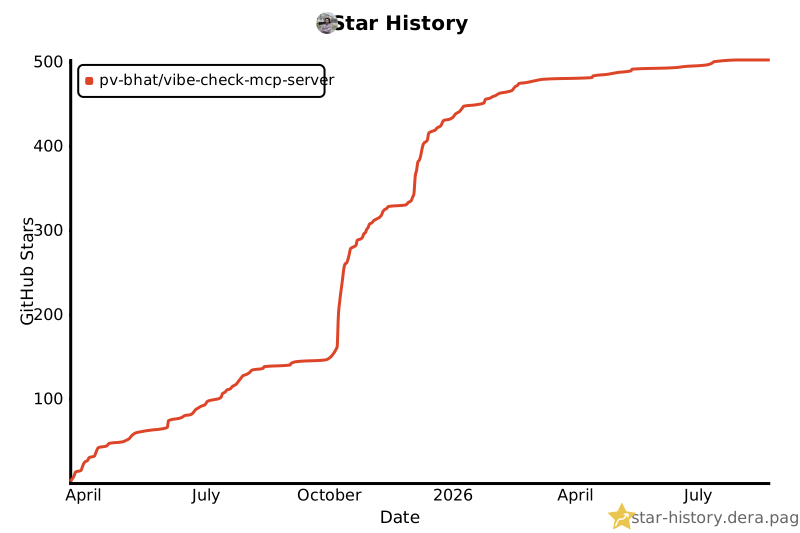
Featured on PulseMCP “Most Popular (This Week)” • 5k+ monthly calls on Smithery.ai • research-backed oversight • STDIO + streamable HTTP transport




Plug-and-play mentor layer that stops agents from over-engineering and keeps them on the minimal viable path — research-backed MCP server keeping LLMs aligned, reflective and safe.
Trusted by developers across MCP platforms and registries
Quickstart (npx)
Run the server directly from npm without a local installation. Requires Node >=20. Choose a transport:
Option 1 – MCP client over STDIO
npx -y @pv-bhat/vibe-check-mcp start --stdio
- Launch from an MCP-aware client (Claude Desktop, Cursor, Windsurf, etc.).
[MCP] stdio transport connected indicates the process is waiting for the client.- Add this block to your client config so it spawns the command:
{
  "mcpServers": {
    "vibe-check-mcp": {
      "command": "npx",
      "args": ["-y", "@pv-bhat/vibe-check-mcp", "start", "--stdio"]
    }
  }
}
Option 2 – Manual HTTP inspection
npx -y @pv-bhat/vibe-check-mcp start --http --port 2091
curl http://127.0.0.1:2091/healthz to confirm the service is live.- Send JSON-RPC requests to
http://127.0.0.1:2091/mcp.
npx downloads the package on demand for both options. For detailed client setup and other commands like install and doctor, see the documentation below.
Recognition
- Featured on PulseMCP “Most Popular (This Week)” front page (week of 13 Oct 2025) 🔗
- Listed in Anthropic’s official Model Context Protocol repo 🔗
- Discoverable in the official MCP Registry 🔗
- Featured on Sean Kochel's Top 9 MCP servers for vibe coders 🔗
Table of Contents
What is Vibe Check MCP?
Vibe Check MCP keeps agents on the minimal viable path and escalates complexity only when evidence demands it. Vibe Check MCP is a lightweight server implementing Anthropic's Model Context Protocol. It acts as an AI meta-mentor for your agents, interrupting pattern inertia with Chain-Pattern Interrupts (CPI) to prevent Reasoning Lock-In (RLI). Think of it as a rubber-duck debugger for LLMs – a quick sanity check before your agent goes down the wrong path.
Overview
Vibe Check MCP pairs a metacognitive signal layer with CPI so agents can pause when risk spikes. Vibe Check surfaces traits, uncertainty, and risk scores; CPI consumes those triggers and enforces an intervention policy before the agent resumes. See the CPI integration guide and the CPI repo at https://github.com/PV-Bhat/cpi for wiring details.
Vibe Check invokes a second LLM to give meta-cognitive feedback to your main agent. Integrating vibe_check calls into agent system prompts and instructing tool calls before irreversible actions significantly improves agent alignment and common-sense. The high-level component map: docs/architecture.md, while the CPI handoff diagram and example shim are captured in docs/integrations/cpi.md.
The Problem: Pattern Inertia & Reasoning Lock-In
Large language models can confidently follow flawed plans. Without an external nudge they may spiral into overengineering or misalignment. Vibe Check provides that nudge through short reflective pauses, improving reliability and safety.
Key Features
What's New in v2.9.0 (Security & Model Refresh)
Maintenance Notice: This project is in maintenance mode and is no longer under active feature development. It remains fully functional and available under the MIT license. Community forks are welcome. For details, see the Changelog.
- Current models: Gemini 3.6 Flash, Claude Sonnet 5 / Opus 5 / Fable 5, and GPT-5.6 Sol / Terra / Luna are now the supported defaults, defined in one registry (
src/utils/models.ts)
- Native Google AI Studio: migrated from the retired
@google/generative-ai package to the unified @google/genai SDK
- HTTP hardening: CORS now defaults to loopback origins instead of
*, Host headers are validated to block DNS rebinding, and the JSON body cap is explicit and validated
- Security:
npm audit is clean — 10 advisories resolved across axios, the MCP SDK's Hono stack, form-data, fast-uri, postcss and the test toolchain
- Dependencies: MCP SDK 1.29, axios 1.18, OpenAI SDK 6.x, vitest 4.x; the unused
body-parser direct dependency was dropped
Session Constitution (per-session rules)
Use a lightweight “constitution” to enforce rules per sessionId that CPI will honor. Eg. constitution rules: “no external network calls,” “prefer unit tests before refactors,” “never write secrets to disk.”
API (tools):
update_constitution({ sessionId, rules }) → merges/sets rule set for the sessionreset_constitution({ sessionId }) → clears session rulescheck_constitution({ sessionId }) → returns effective rules for the session
Development Setup
# Clone and install
git clone https://github.com/PV-Bhat/vibe-check-mcp-server.git
cd vibe-check-mcp-server
npm ci
npm run build
npm test
Use npm for all workflows (npm ci, npm run build, npm test). This project targets Node >=20.
Create a .env file with the API keys you plan to use:
# Gemini (default)
GEMINI_API_KEY=your_gemini_api_key
# Optional providers / Anthropic-compatible endpoints
OPENAI_API_KEY=your_openai_api_key
OPENROUTER_API_KEY=your_openrouter_api_key
ANTHROPIC_API_KEY=your_anthropic_api_key
ANTHROPIC_AUTH_TOKEN=your_proxy_bearer_token
ANTHROPIC_BASE_URL=https://api.anthropic.com
ANTHROPIC_VERSION=2023-06-01
# Optional overrides
# DEFAULT_LLM_PROVIDER accepts gemini | openai | openrouter | anthropic
DEFAULT_LLM_PROVIDER=gemini
# Leave DEFAULT_MODEL unset to use each provider's default (see table below)
# DEFAULT_MODEL=gemini-3.6-flash
Providers and models
Gemini runs natively against Google AI Studio (the Gemini Developer API) through the unified @google/genai SDK. Any model ID the provider accepts will work — the table lists the defaults and the suggestions surfaced to agents in the vibe_check tool schema.
Set the default globally with DEFAULT_LLM_PROVIDER / DEFAULT_MODEL, or per call with modelOverride. DEFAULT_MODEL names a model of DEFAULT_LLM_PROVIDER; a call that overrides the provider without naming a model falls through to that provider's default rather than reusing it.
{ "goal": "...", "plan": "...", "modelOverride": { "provider": "anthropic", "model": "claude-opus-5" } }
If a Gemini call fails, the server retries once against gemini-3.5-flash-lite before falling back to static questions.
HTTP transport hardening
These apply only to --http mode; stdio is unaffected.
Upgrading to v2.9.0 over HTTP: if you serve Vibe Check on a non-loopback hostname (Docker, a reverse proxy, a hosted deployment), set MCP_ALLOWED_HOSTS to that hostname — or * — or requests will be rejected with HTTP 403.
Configuration
See docs/TESTING.md for instructions on how to run tests.
Docker
The repository includes a helper script for one-command setup.
bash scripts/docker-setup.sh
See Automatic Docker Setup for full details.
Provider keys
See API Keys & Secret Management for supported providers, resolution order, storage locations, and security guidance.
Transport selection
The CLI supports stdio and HTTP transports. Transport resolution follows this order: explicit flags (--stdio/--http) → MCP_TRANSPORT → default stdio. When using HTTP, specify --port (or set MCP_HTTP_PORT); the default port is 2091. The generated entries add --stdio or --http --port <n> accordingly, and HTTP-capable clients also receive a http://127.0.0.1:<port> endpoint.
Client installers
Each installer is idempotent and tags entries with "managedBy": "vibe-check-mcp-cli". Backups are written once per run before changes are applied, and merges are atomic (*.bak files make rollback easy). See docs/clients.md for deeper client-specific references.
Claude Desktop
- Config path:
claude_desktop_config.json (auto-discovered per platform).
- Default transport: stdio (
npx … start --stdio).
- Restart Claude Desktop after installation to load the new MCP server.
- If an unmanaged entry already exists for
vibe-check-mcp, the CLI leaves it untouched and prints a warning.
Cursor
- Config path:
~/.cursor/mcp.json (provide --config if you store it elsewhere).
- Schema mirrors Claude’s
mcpServers layout.
- If the file is missing, the CLI prints a ready-to-paste JSON block for Cursor’s settings panel instead of failing.
Windsurf (Cascade)
- Config path: legacy
~/.codeium/windsurf/mcp_config.json, new builds use ~/.codeium/mcp_config.json.
- Pass
--http to emit an entry with serverUrl for Windsurf’s HTTP client.
- Existing sentinel-managed
serverUrl entries are preserved and updated in place.
Visual Studio Code
- Workspace config lives at
.vscode/mcp.json; profiles also store mcp.json in your VS Code user data directory.
- Provide
--config <path> to target a workspace file. Without --config, the CLI prints a JSON snippet and a vscode:mcp/install?... link you can open directly from the terminal.
- VS Code supports optional dev fields; pass
--dev-watch and/or --dev-debug <value> to populate dev.watch/dev.debug.
Uninstall & rollback
- Restore the backup generated during installation (the newest
*.bak next to your config) to revert immediately.
- To remove the server manually, delete the
vibe-check-mcp entry under mcpServers (Claude/Windsurf/Cursor) or servers (VS Code) as long as it is still tagged with "managedBy": "vibe-check-mcp-cli".
Research & Philosophy
CPI (Chain-Pattern Interrupt) is the research-backed oversight method behind Vibe Check. It injects brief, well-timed “pause points” at risk inflection moments to re-align the agent to the user’s true priority, preventing destructive cascades and reasoning lock-in (RLI). In pooled evaluation across 153 runs, CPI nearly doubles success (~27%→54%) and roughly halves harmful actions (~83%→42%). Optimal interrupt dosage is ~10–20% of steps. Vibe Check MCP implements CPI as an external mentor layer at test time.
Links:
flowchart TD
  A[Agent Phase] --> B{Monitor Progress}
  B -- high risk --> C[CPI Interrupt]
  C --> D[Reflect & Adjust]
  B -- smooth --> E[Continue]
Agent Prompting Essentials
In your agent's system prompt, make it clear that vibe_check is a mandatory tool for reflection. Always pass the full user request and other relevant context. After correcting a mistake, you can optionally log it with vibe_learn to build a history for future analysis.
Example snippet:
As an autonomous agent you will:
1. Call vibe_check after planning and before major actions.
2. Provide the full user request and your current plan.
3. Optionally, record resolved issues with vibe_learn.
Documentation
Security
This repository includes a CI-based security scan that runs on every pull request. It checks dependencies with npm audit and scans the source for risky patterns. See SECURITY.md for details and how to report issues.
Roadmap
Note: This project is in maintenance mode (latest maintenance release: v2.9.0). The roadmap below is preserved for community forks that may wish to continue development.
- Structured output for
vibe_check: Return a JSON envelope such as { advice, riskScore, traits } so downstream agents can reason deterministically.
- LLM resilience: Wrap
generateResponse with retries and exponential backoff.
- Input sanitization: Validate and cleanse tool arguments to mitigate prompt-injection vectors.
- Prompt externalization: Move hardcoded prompts to configuration files for transparency and auditability (see PR #71).
Contributions are welcome! See CONTRIBUTING.md.

Links
Credits & License
Vibe Check MCP is released under the MIT License. Built for reliable, enterprise-ready AI agents.
Author Credits & Links
Vibe Check MCP created by: Pruthvi Bhat, Initiative - https://murst.org/