Adaptive Cards MCP








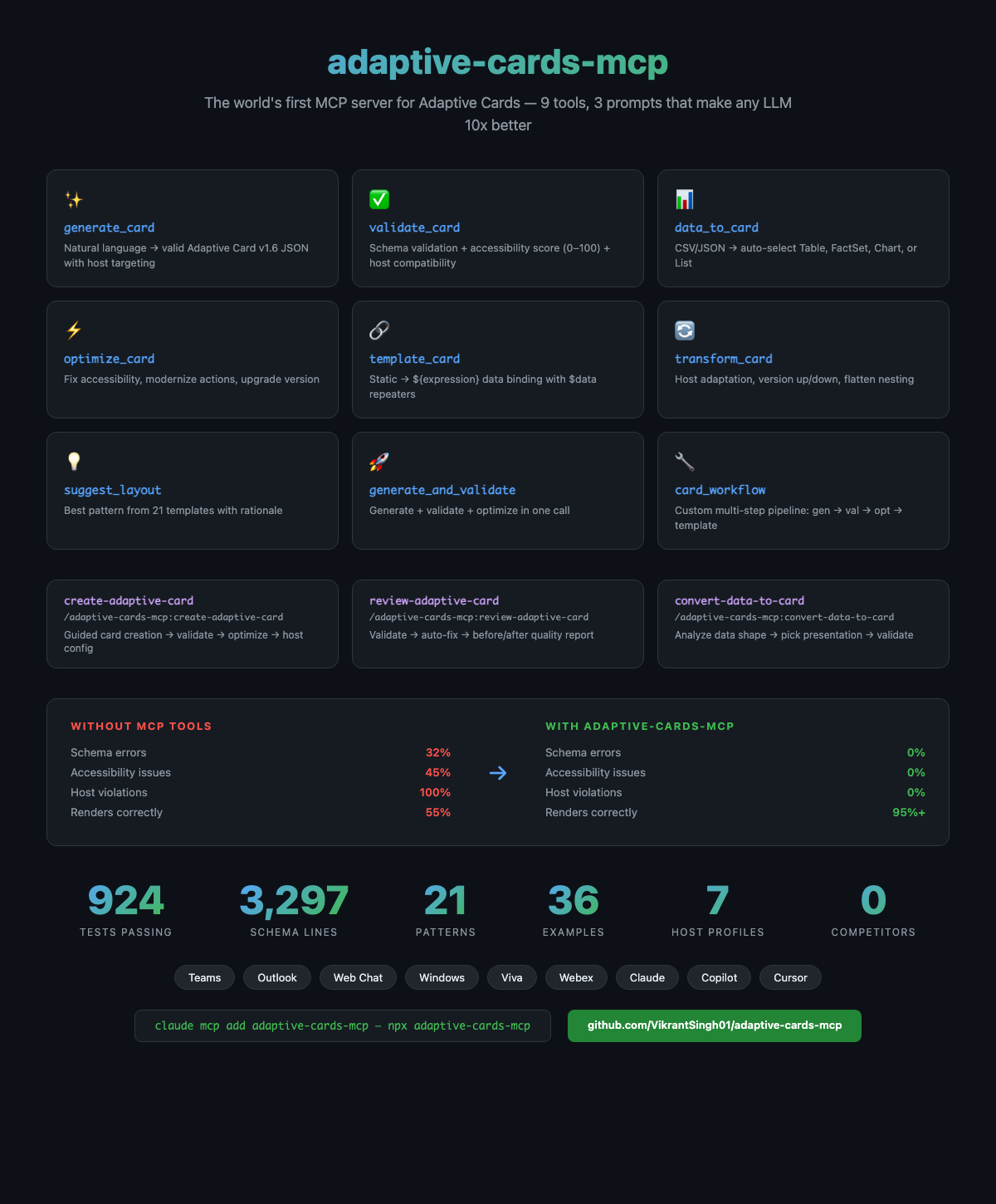
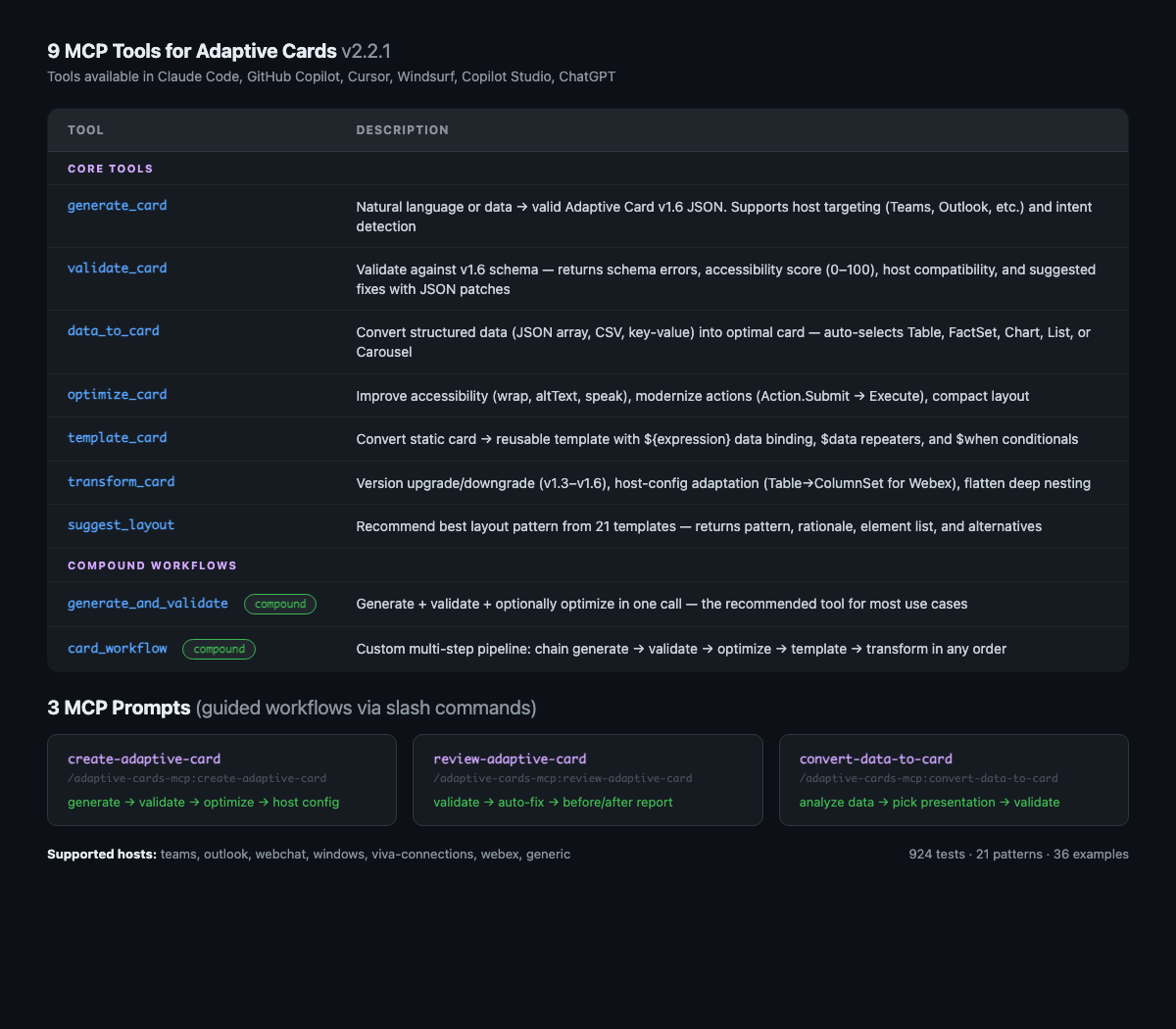
An MCP server that helps AI assistants generate valid, accessible Adaptive Cards for Teams, Outlook, Copilot, and other Microsoft surfaces. 9 tools, 3 guided workflows, 924 tests.
Blog: I Built an MCP Server That Makes AI 10x Better at Adaptive Cards
Demo
Your browser does not support the video tag.
Quick Start
No install needed — npx downloads and runs it automatically.
1. Add to your AI assistant
Claude Code
claude mcp add adaptive-cards-mcp -- npx adaptive-cards-mcp
GitHub Copilot (VS Code)
Add to .vscode/mcp.json:
{
  "servers": {
    "adaptive-cards-mcp": {
      "command": "npx",
      "args": ["adaptive-cards-mcp"]
    }
  }
}
Cursor
Add to .cursor/mcp.json:
{
  "mcpServers": {
    "adaptive-cards-mcp": {
      "command": "npx",
      "args": ["adaptive-cards-mcp"]
    }
  }
}
Windsurf
Add to ~/.codeium/windsurf/mcp_config.json:
{
  "mcpServers": {
    "adaptive-cards-mcp": {
      "command": "npx",
      "args": ["adaptive-cards-mcp"]
    }
  }
}
Microsoft 365 Copilot / Copilot Studio (HTTP/SSE)
TRANSPORT=sse PORT=3001 npx adaptive-cards-mcp

# With auth enabled
TRANSPORT=sse MCP_API_KEY=your-secret npx adaptive-cards-mcp
- Open Copilot Studio → your agent → Tools → Add a tool → New tool → Model Context Protocol
- Enter your MCP server URL (e.g.,
https://your-server.azurewebsites.net/sse)
- Select the tools to expose
OpenAI ChatGPT
- Enable Developer mode in ChatGPT settings
- Go to Settings → Connectors → Create
- Enter your MCP server HTTPS URL
2. Start using it
Just ask your AI assistant in natural language:
> Create an expense approval card for Teams
> Convert this JSON data into an Adaptive Card table
> Validate this card and fix accessibility issues
> Make this card work on Outlook (v1.4)
The AI picks the right tools, generates a valid card, validates it, and returns production-ready JSON you can paste directly into the Adaptive Cards Designer to preview.
Usage
Natural language (recommended)
Describe what you need — the AI figures out which tools to call:
Approvals and workflows:
> Create an expense approval card for Teams with requester photo, amount,
  category, line items, and approve/reject/comment buttons
> Build a time-off request card — employee name, dates, remaining PTO balance,
  manager approval with optional rejection reason
Notifications and alerts:
> Create a CI/CD deployment notification: service name, environment, build number,
  commit SHA, deploy status with rollback button
> Generate a PagerDuty-style incident alert card — severity P1, affected service,
  start time, on-call engineer, acknowledge/escalate actions
Data and reports:
> Here's our Q1 sales data, turn it into a card:
  [{"region":"APAC","revenue":1250000,"growth":"12%"},
   {"region":"EMEA","revenue":980000,"growth":"8%"},
   {"region":"Americas","revenue":2100000,"growth":"15%"}]
> Convert this CSV to a card:
  Employee,Department,Start Date,Status
  Jane Kim,Engineering,2026-01-15,Active
  Bob Lee,Design,2026-02-01,Active
  Carol Wu,PM,2026-03-10,Onboarding
Forms and input:
> Create an employee onboarding checklist — new hire name, start date,
  assigned buddy, IT setup tasks with checkboxes, and a submit button
> Build a customer feedback survey card with a 1-5 star rating,
  comment field, and NPS score dropdown
Profiles and status:
> Create a team member profile card with photo, name, title, department,
  skills tags, and contact buttons for email/chat/calendar
> Build a service health dashboard card showing 5 microservices
  with status indicators (healthy/degraded/down) and last check time
Cross-host and versioning:
> This card works in Teams but breaks in Outlook — fix it
> Make this card work on Webex (v1.3 only, no Table, no Action.Execute)
> Downgrade this v1.6 card to v1.4 for Viva Connections
Validation and optimization:
> Validate this card and tell me what's wrong — I'm getting render errors
> Make this card accessible — it needs to work with screen readers
> This card is too complex, optimize it for performance and compact layout
Slash commands (MCP prompts)
For guided, multi-step workflows, use the built-in prompts directly:
Create a card:
> /adaptive-cards-mcp:create-adaptive-card
  description: "Expense approval with requester photo, line items table, total amount,
                and approve/reject buttons with comment field"
  host: teams
  intent: approval
Runs: generate → validate → optimize → host config
> /adaptive-cards-mcp:create-adaptive-card
  description: "CI/CD deployment notification with service name, environment,
                build number, status badge, and rollback action"
  host: teams
  intent: notification
> /adaptive-cards-mcp:create-adaptive-card
  description: "Employee profile card with photo, name, title, department,
                contact info, and skills tags"
  host: outlook
  intent: profile
Convert data to a card:
> /adaptive-cards-mcp:convert-data-to-card
  data: [
    { "task": "Review PR #482", "assignee": "Jane", "due": "2026-03-21", "status": "pending" },
    { "task": "Deploy hotfix v2.1.3", "assignee": "Bob", "due": "2026-03-19", "status": "in-progress" },
    { "task": "Update API docs", "assignee": "Carol", "due": "2026-03-22", "status": "done" }
  ]
  title: "Sprint Tasks"
  presentation: table
> /adaptive-cards-mcp:convert-data-to-card
  data: { "service": "api-gateway", "cpu": "92%", "memory": "78%", "requests": "12.4k/min",
          "p99_latency": "245ms", "error_rate": "0.3%", "uptime": "99.97%" }
  title: "Service Health — api-gateway"
  presentation: facts
Runs: analyze data → pick best layout → validate output
Review an existing card:
> /adaptive-cards-mcp:review-adaptive-card
  card: { "type": "AdaptiveCard", "version": "1.6", "body": [...your card...] }
  host: outlook
Runs: validate schema + accessibility → auto-fix issues → summary report
npm library (programmatic)
For use in your own code (bots, APIs, CI pipelines), install the package:
npm install adaptive-cards-mcp
import { generateCard, validateCardFull, dataToCard, optimizeCard } from 'adaptive-cards-mcp';

const result = await generateCard({
  content: "Create a flight status card",
  host: "teams",
  intent: "display"
});

console.log(result.card);       // Adaptive Card JSON
console.log(result.cardId);     // Reference ID for subsequent calls
console.log(result.validation); // Schema + accessibility + host compat
See the Library API reference for full details.
What you get back
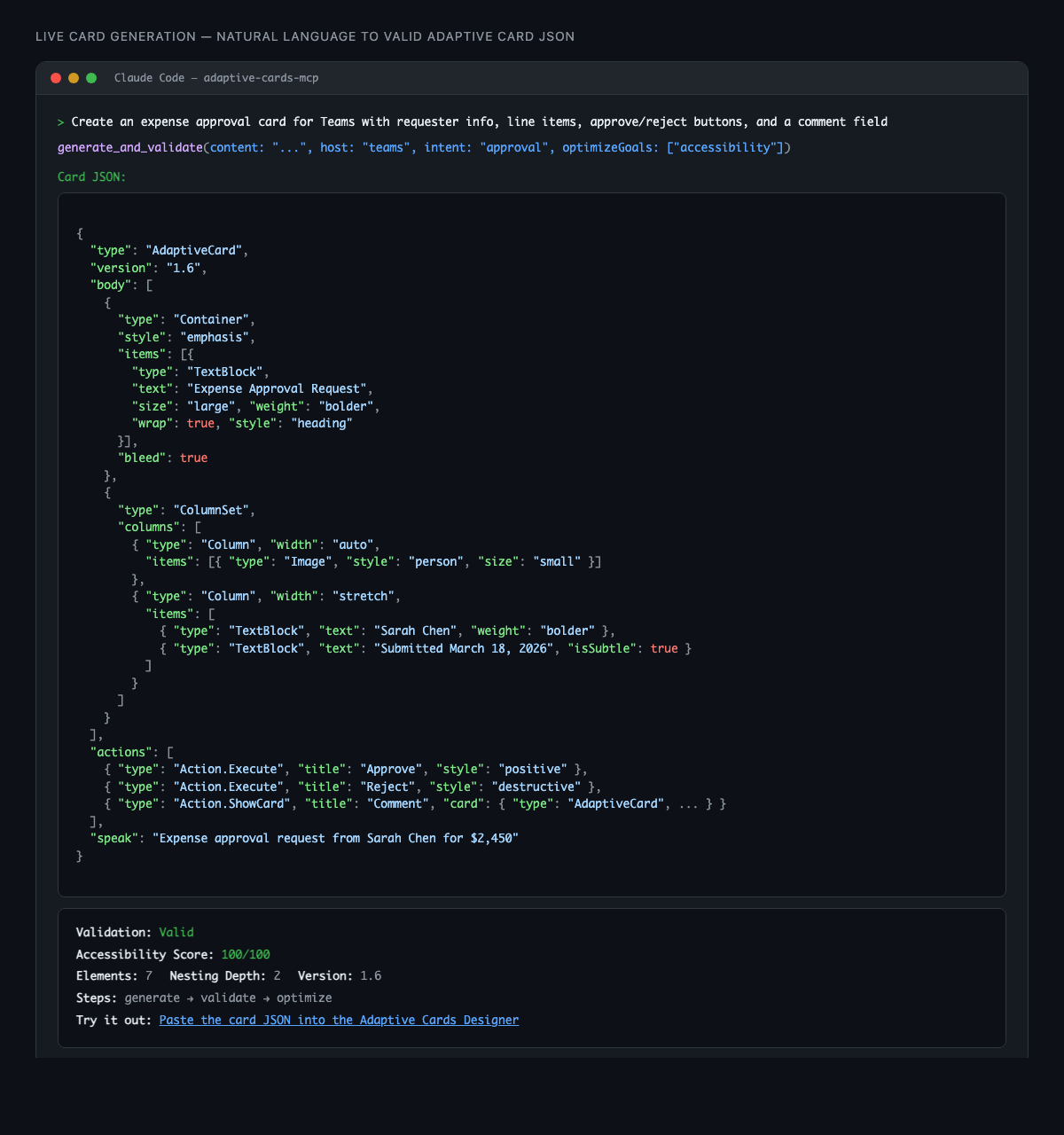
Card-producing tools return two clean blocks — card JSON you can copy, and a metadata summary:
```json
{
  "type": "AdaptiveCard",
  "version": "1.6",
  "body": [ ... ],
  "actions": [ ... ]
}
```

---

**Validation:** Valid
**Accessibility Score:** 100/100
**Elements:** 7 | **Nesting Depth:** 2 | **Version:** 1.6
**Card ID:** card-abc123
**Steps:** generate → validate → optimize
**Try it out:** Paste the card JSON into the [Adaptive Cards Designer](https://adaptivecards.microsoft.com/designer)
**Local Preview:** file:///tmp/ac-preview-xyz.html
Reference
MCP Prompts (3)
MCP Resources (5) + Templates (2)
Host Compatibility
Configuration
Note: When used via MCP (Claude Code, Copilot, Cursor), the host LLM provides the intelligence — no API key needed. Set an API key only for standalone/library usage.
Telemetry & Privacy
Telemetry is opt-in and disabled by default. When enabled, the server collects
anonymous usage metrics and sends aggregated data to PostHog to help improve the project.
How to enable:
- VS Code extension: A one-time consent prompt appears on first install. You can
change it anytime in Settings → Adaptive Cards → Telemetry.
- CLI / MCP server: Set
MCP_TELEMETRY=true in your environment, or edit
~/.adaptive-cards-mcp/config.json and set "telemetry": true.
What is sent: Tool names, call counts, durations, error rates, platform (OS),
Node version, package version, transport type.
What is never sent: Card content, user prompts, data payloads, IP addresses,
file paths, environment variables.
A random session ID is generated each time the server starts — no persistent
identifier is stored across sessions.
To disable: Set MCP_TELEMETRY=false or leave unconfigured (default is off).
Development
cd packages/core
npm install
npm run build         # TypeScript + copy data files
npm test              # 924 tests (vitest)
npm run test:coverage # With coverage report
npm run lint          # TypeScript type check
npm run lint:eslint   # ESLint check
npm run format        # Prettier formatting
Local Testing
Smoke test all tools and prompts:
./test-mcp-tools.sh --local     # 28 tests — all 9 tools with real-world scenarios
./test-mcp-prompts.sh --local   # 10 tests — all 3 prompts (guided workflows)
./test-mcp-tools.sh             # same tests against published npm package
./test-mcp-prompts.sh           # same tests against published npm package
MCP Inspector (visual UI):
cd packages/core && npm run build
npx @modelcontextprotocol/inspector node dist/server.js
# Opens http://localhost:6274 — pick a tool, enter params, click Run
Terminal (stdio):
cd packages/core
echo '{"jsonrpc":"2.0","id":1,"method":"initialize","params":{"protocolVersion":"2024-11-05","capabilities":{},"clientInfo":{"name":"test","version":"1.0"}}}
{"jsonrpc":"2.0","id":2,"method":"tools/call","params":{"name":"generate_card","arguments":{"content":"expense approval card","intent":"approval","host":"teams"}}}' \
  | node dist/server.js 2>/dev/null | tail -1 | python3 -m json.tool
SSE mode:
TRANSPORT=sse PORT=3001 node packages/core/dist/server.js
curl http://localhost:3001/health
Architecture
packages/core/src/
├── server.ts              # MCP server (stdio + SSE, 9 tools, 3 prompts)
├── index.ts               # Library exports
├── types/                 # TypeScript interfaces
├── core/                  # Schema validator, analyzer, accessibility, host compat
├── generation/            # 21 layout patterns, data analyzer, assembler, LLM client
├── tools/                 # 9 tool handlers
├── utils/                 # Logger, input guards, rate limiter, card store, auth, telemetry, preview
└── data/                  # v1.6 schema, 36 examples, host configs
Ecosystem
What's New in v2.3.0
- Accessibility 100/100 — All generated cards now include
speak property automatically
- No more broken JSON — Newlines in content sanitized, titles no longer truncate at version numbers
- Host-aware generation —
generate_and_validate auto-downgrades card version for Outlook (v1.4), Webex (v1.3)
- CSV fix — CSV data correctly parsed before building FactSet/Table cards
- Telemetry —
/metrics endpoint with session tracking, per-tool call distribution, host/intent usage
- MCP Registry — Listed on the official MCP Registry
- E2E test suite — 28 tool tests + 10 prompt tests with quality gates (a11y score, element count)
See the full CHANGELOG for details.
Links
- npm — Install and package details
- GitHub — Source code, issues, and contributions
- MCP Registry — Official MCP server listing
License
MIT